A clearer path for global public health reporting
Modern public health reporting systems must reconcile different standards, regulations and workflows while delivering data that is timely, accurate and ready to act on.
Disease doesn’t stop at a jurisdictional boundary. Public health reporting, however, is often divided by varying regulations, local processes, technical standards and agency-specific requirements.
This summer, a Cyclospora outbreak is showing how public health reporting works under pressure. As of July 16, investigators had identified 1,644 illnesses and 94 hospitalizations linked to shredded iceberg lettuce served at fast food locations in five states. By connecting patient interviews, meal histories and distribution records, officials traced the lettuce to a single supplier, demonstrating how quickly fragmented data must become actionable intelligence.
The progress possible when barriers are addressed can be significant. In the World Health Organization’s Western Pacific Region, the interval between the emergence of a health threat and its official notification under the International Health Regulations fell from 20 days in 2023 to 48 hours in 2025. That improvement illustrates how stronger surveillance capacity can accelerate awareness and response. It also shows how much depends on the infrastructure operating behind every report.
A hospital, laboratory or health department may need to share related information with state or national authorities, the Centers for Disease Control and Prevention, the European Centre for Disease Prevention and Control or WHO. Each may require different data elements, formats, case definitions, privacy protections and submission schedules.
Effective reporting depends on preserving the accuracy, meaning and security of data as it moves across these systems.
Related: The next public health outbreak will reveal your cracks
Consistency begins with shared meaning
Standards such as HL7 and FHIR provide common structures for exchanging health information. Vocabularies such as ICD, SNOMED CT and LOINC help systems describe diagnoses, clinical findings and laboratory results consistently.
But using the same standards doesn’t guarantee that different organizations interpret data the same way.
Systems may use different terminology versions or apply different definitions for suspected, probable and confirmed cases. Dates may refer to specimen collection, symptom onset, diagnosis or submission. Geographic information may need to be converted into recognized national or regional classifications.
Reporting pipelines must harmonize these elements and provide enough metadata for receiving authorities to understand how the information was collected, classified and transformed. Otherwise, records can meet technical requirements while still producing misleading trends or unreliable comparisons.
Related: Public health is only as strong as its data
Quality must be operational
Harmonization establishes what the data means. Quality controls determine whether each record is complete, valid and ready to report.
Public health information may originate in electronic health records, laboratory systems and disease surveillance platforms. Missing fields, duplicate cases, invalid codes and incomplete classifications can accumulate as information passes between them.
A modern reporting environment should identify these problems before submission. Automated validation can confirm that required fields are present, values fall within acceptable ranges and terminology matches the correct schema. Deduplication, provenance records and audit trails give teams the context needed to resolve errors and explain how information was handled.
Automation must also extend beyond receipt. In 2026, at least 70% of federally funded health departments connected to a national electronic case reporting service were processing that information into production disease surveillance systems, according to CDC.
The milestone reflects meaningful progress, but it also highlights an important distinction: receiving a report is not the same as making it operational. Agencies must be able to validate, route and use incoming information without recreating manual work downstream.
Privacy must reflect the use case
The information needed for surveillance may include personally identifiable information or protected health information. Reporting obligations also vary by jurisdiction, disease and purpose.
A U.S. authority may require identifiable information for an investigation, while an international submission may require de-identification or pseudonymization. HIPAA, GDPR and international reporting requirements create overlapping responsibilities that cannot be addressed through one fixed privacy policy.
Reporting infrastructure needs adaptable controls that apply the minimum necessary standard for each destination and use case. Encryption, role-based access, retention rules, secure interfaces and detailed logging should be incorporated from the beginning.
These protections help preserve individual privacy without preventing authorized public health professionals from receiving the information needed to identify and manage emerging threats.
Resilience turns speed into reliability
During an outbreak, even a sophisticated system provides limited value if failed messages remain unnoticed.
Reporting infrastructure must support scheduled and near-real-time submissions, monitor delays, preserve messages during outages and retry unsuccessful deliveries. When an authority returns a schema error or validation report, the response should be captured and directed to the appropriate data steward.
Feedback should also improve future submissions. Tracking recurring errors can reveal outdated mappings, misunderstood requirements or weaknesses in source data. Version-controlled definitions, jurisdiction-specific rules and modular interfaces allow teams to make targeted changes without rebuilding the entire pipeline.
That flexibility is increasingly important as global requirements change. Amendments to the International Health Regulations entered into force in 2025, introducing a new “pandemic emergency” alert level and additional mechanisms for international coordination, according to WHO.
Turning public health data into action
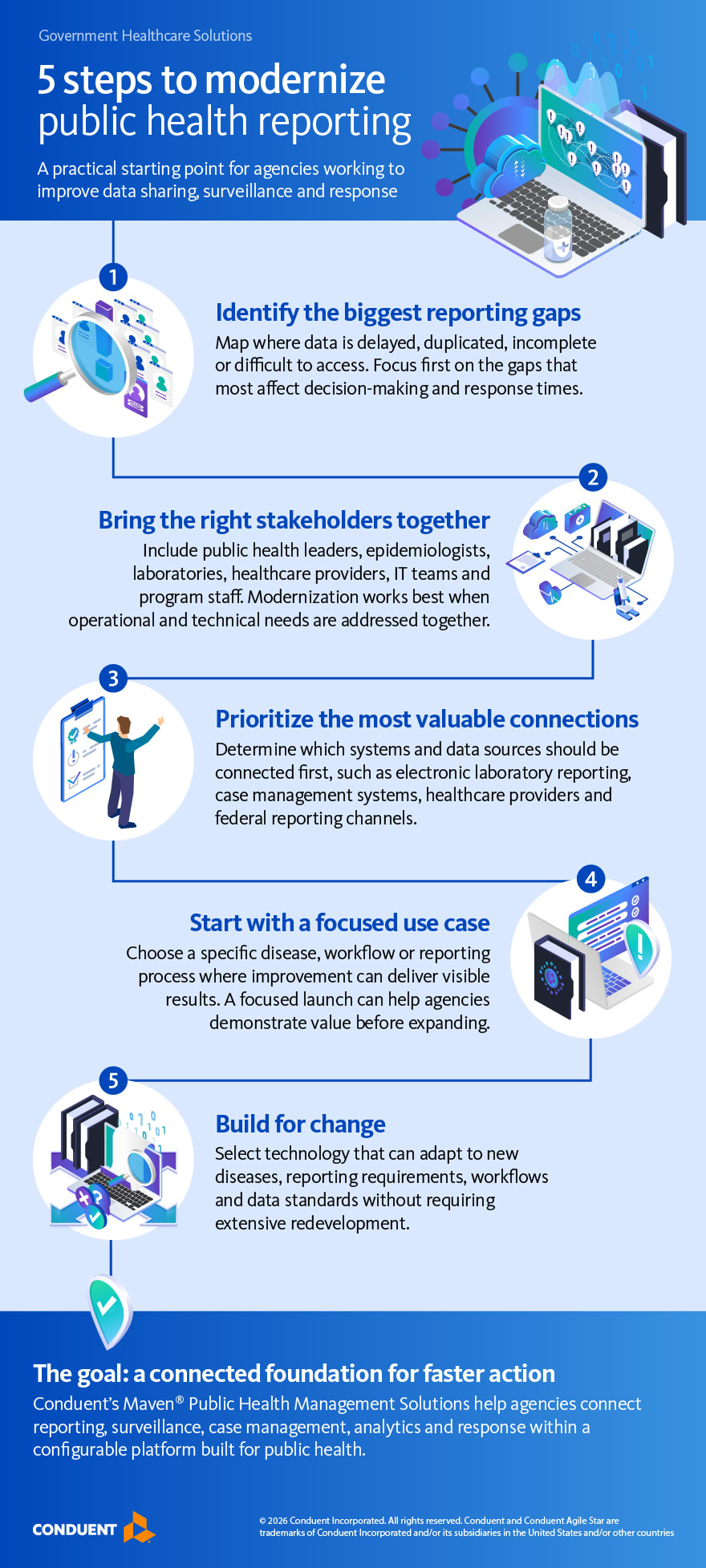
Better reporting depends on more than moving information across borders. Agencies also need a way to connect incoming data with case management, disease surveillance, investigation and response.
Conduent’s Maven® Public Health Management Solutions bring those capabilities together in a configurable, cloud-based platform built specifically for public health. Maven helps agencies securely track cases and exposures, automate reporting, manage disease-specific workflows and share timely information across laboratories, healthcare providers, epidemiologists and government organizations.
The platform supports interoperability through standards such as HL7 and electronic laboratory reporting, while embedded analytics, GIS tools and geographic visualizations help public health teams identify patterns, locate emerging outbreaks and act on changing conditions. No-code configuration allows agencies to adapt workflows and rules without extensive development, and prebuilt modules can support faster responses to new threats and program needs.
Maven currently supports more than 100 public health programs across over 50 jurisdictions and helps protect more than 190 million people worldwide. Backed by epidemiologists and continuously updated as a managed SaaS platform, it gives agencies the infrastructure and expertise needed to turn complex public health information into coordinated action.
Related: Video: Maven-Integrated Disease Surveillance and Outbreak Management Platform
Is your data ready to support better decisions?
Connect with our team to see how Maven helps public health agencies turn data into action. Learn more now and connect with an expert.