What's next is now: Medicaid’s new chapter has begun
Modernization has long been a goal for Medicaid programs. Now, the benefits are coming into focus.
For years, consultants touting Medicaid modernization have put forward familiar promises: more flexible systems, stronger security, better data, faster implementation and more useful tools for the people responsible for running complex programs every day.
For many agencies, modernization used to live in the gap between what was possible and what was practical. The vision was clear, but the technology and implementation path often lagged behind the ambition.
In just the past year, however, the conversation has turned a corner. What once sounded like the next, far-off era of Medicaid is now beginning to appear in live state operations, with real implications for administrators, providers and the residents they serve.
That shift matters to me because I’ve spent much of my career where government, healthcare operations and technology meet. Before joining Conduent, I worked inside Massachusetts state government, supported Medicaid and long-term care programs, and partnered with public agencies across state and global health markets. That experience shapes how I see modernization — not as a technology exercise, but to help agencies work better and serve people more effectively.
Related: Building stronger Medicaid data operations
Modern Medicaid systems are built for change
Medicaid agencies operate in a demanding environment. They manage changing federal requirements, state-specific policies, waiver complexity, provider needs, claims accuracy, program integrity and rising expectations from residents. Yet most agencies still rely on legacy Medicaid Management Information Systems from a different technology era. Think COBOL and mainframes that predate the cloud by at least a few geological layers.
However, that is starting to change. The next generation of Medicaid technology is already here: cloud-native, modular, interoperable and configurable. It marks a major shift from the monolithic systems states have long maintained, giving agencies platforms that can adapt to their business rules and operational priorities.
The future has taken shape … in New Mexico
The New Mexico Health Care Authority serves nearly 900,000 Medicaid members through its Turquoise Care program and works with a provider community of about 94,000. As program demands grew, the state set out to modernize a 24-year-old Medicaid Management Information System (MMIS) and build a more connected, responsive Medicaid enterprise.
Through its HHS 2020 initiative and MMIS Replacement project, administrators chose a modular path. Our teams deployed Conduent Medicaid Suite, a cloud-based platform designed to support incremental modernization while helping the state advance toward MITA Maturity Level 4.
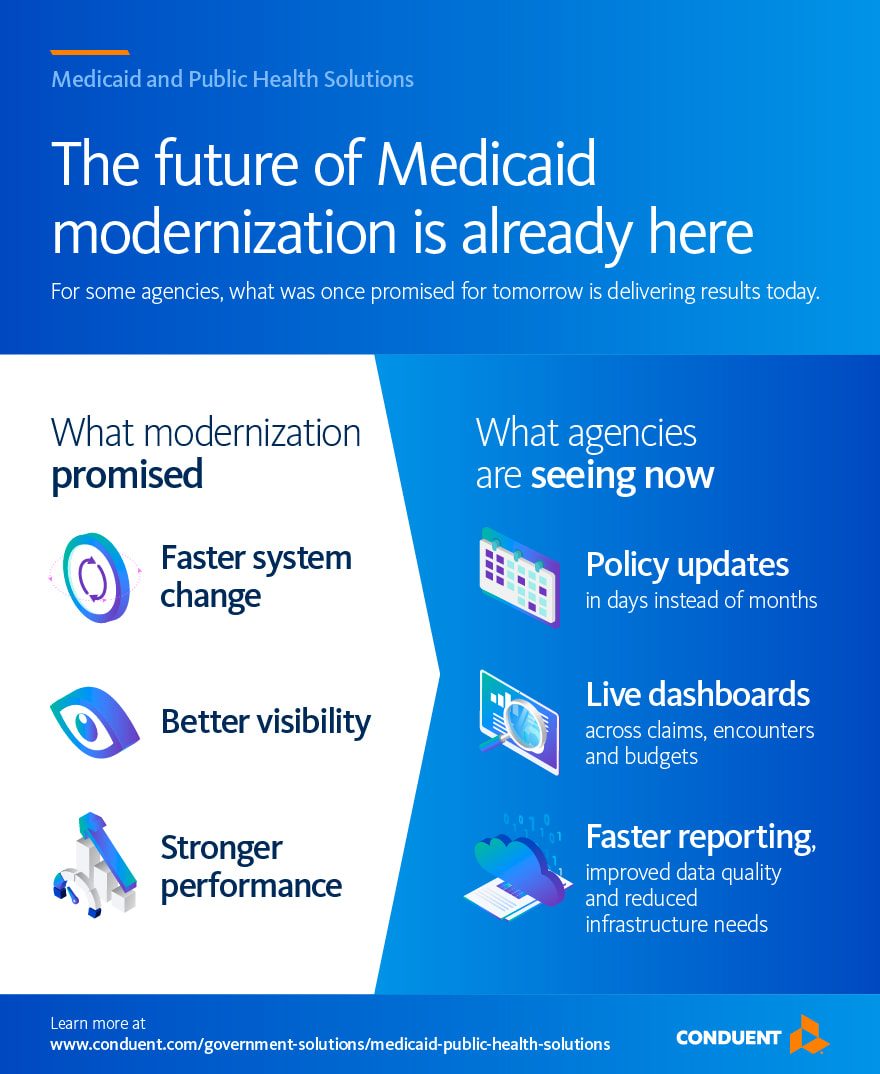
The work shows what modernization looks like when it moves from promise to practice. New Mexico can now implement some policy updates in days rather than months. Officials have live dashboards for greater visibility into claims, encounter data and budget performance. Real-time eligibility checks help speed claims processing and support faster provider payments. The platform also strengthens third-party liability identification, helping reduce unnecessary expenditures and protect funding for member care.
The scale is significant, resulting in more than 470,000 managed care encounters and 106,000 fee-for-service claims processed each week, with 234 system integrations completed across the Medicaid ecosystem.
These capabilities are already helping New Mexico improve automation, strengthen reporting and data quality, support providers more efficiently and build a foundation that can adapt as Medicaid needs continue to change.
Related: Why the smartest Medicaid states are modernizing in motion
Medicaid data modernization is already delivering results
The same shift is happening in Medicaid data operations. In Colorado, Conduent assumed responsibility for a statewide enterprise data warehouse supporting Medicaid and other public health programs for approximately 1.3 million residents.
The work focused on stabilizing the existing EDW environment, improving data quality monitoring and governance, optimizing ETL and SQL performance and enabling secure access through single sign-on.
This led to reduced hardware requirements by more than 50%, faster data load and query times, clearer governance practices and stronger operational transparency. For state Medicaid leaders, that means a more reliable foundation for analytics, reporting and data-driven decision-making.
Implementation has a new playbook
No two Medicaid programs are exactly alike. Each state brings its own requirements, waivers, provider environment and program goals. A modern Medicaid platform must support that uniqueness.
Today’s systems help agencies move from written requirements to working models more quickly, giving teams something they can review, test and refine earlier in the process. That can reduce implementation risk, improve alignment and support continuous improvement over time.
AI is making modernization more practical
In implementation, agentic AI can help interpret business requirements and support workflow and rules configurations. That can shorten the path from RFP language and policy requirements to working prototypes that agency teams can validate and improve.
But AI doesn’t replace the expertise of Medicaid professionals. Strong quality control, client review and user acceptance testing remain essential. The goal is to reduce repetitive manual work, not replace the judgment and experience that make Medicaid programs successful.
Related: Modernizing Medicaid without a full system replacement
Connected data supports better decisions
When data moves more effectively, agencies can identify outliers earlier, strengthen program integrity and measure outcomes with greater confidence, and teams can move from reactive operations to more proactive program management.
The opportunity is here now
Modernization works best when it combines advanced technology with deep program experience. Medicaid systems reflect decades of policy, compliance, operations and service delivery knowledge. The strongest solutions bring that experience forward while applying the capabilities now available through cloud-native platforms and AI-enabled automation.
For states, the opportunity is clear: implement more secure, flexible and data-driven solutions that support staff, strengthen operations and improve service for residents.
To learn more, connect with our Medicaid experts about how modern, modular solutions can help states prepare for what comes next.