The world is connected. Public health data should be, too.
From local laboratories to global surveillance networks, shared data standards and closer collaboration can turn early warnings into faster action and more equitable outcomes.
Public health agencies have more information at their disposal than ever before. Yet differences in reporting systems, data definitions and institutional practices can prevent that information from reaching the people who need it.
A 2023 study published in The Lancet Global Health found that 73% of the 41 public health events examined across five countries failed to meet all three international benchmarks for timely detection, notification and early response, underscoring the need for stronger coordination and faster information sharing.
Closing these gaps requires something more ambitious than connecting technology. It calls for radical collaboration: a shared commitment to making health information accurate, accessible and actionable across organizations and borders.
A common language for faster action
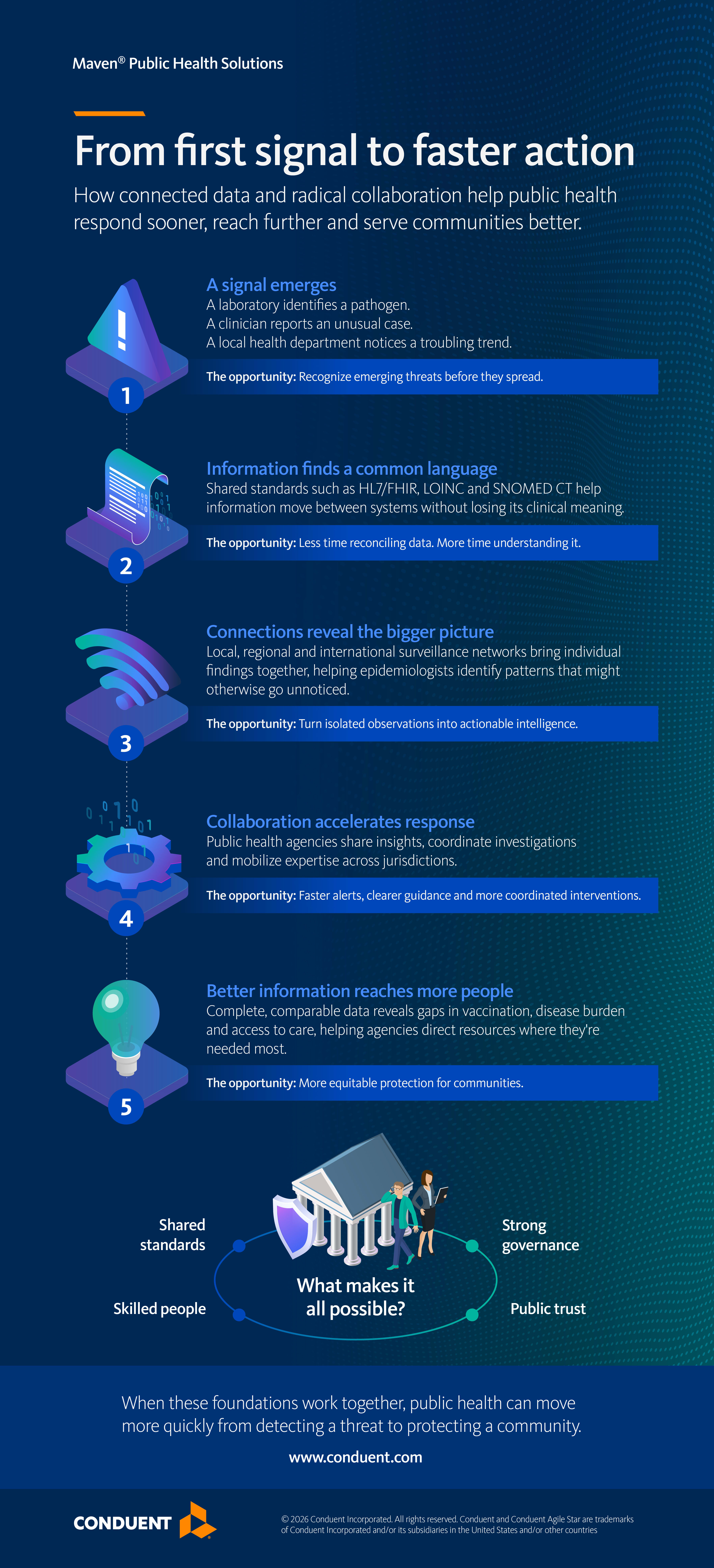
Consider what happens when a laboratory reports a positive test result. That information may travel through several systems before reaching the epidemiologist responsible for investigating it. Along the way, inconsistent terminology or incomplete records can introduce delays and uncertainty.
Common data standards help preserve the meaning of information as it moves.
Standards such as HL7 and FHIR support health information exchange. LOINC and SNOMED CT establish consistent terminology for laboratory observations and clinical concepts, while LIVD helps connect diagnostic device results to standardized codes.
Together, these standards create the foundation for more reliable surveillance. But their value depends on how consistently organizations implement them.
The CDC’s case surveillance modernization efforts and the European Centre for Disease Prevention and Control’s (ECDC) digital transformation initiatives reflect this principle, bringing public health agencies together to standardize data, streamline reporting and improve information exchange across jurisdictions and borders.
The result can be less time reconciling records and more time investigating potential threats.
Related: How better-connected data strengthens public health response
From local signals to global understanding
Disease surveillance begins locally, but its implications rarely end there.
The World Health Organization's International Health Regulations establish a framework for countries to detect, assess, notify and respond to public health risks. In Africa, the Integrated Disease Surveillance and Response strategy helps translate these expectations into routine surveillance and response practices.
International networks extend that collaboration further. WHO's Global Outbreak Alert and Response Network mobilizes expertise and resources during emergencies, while its Epidemic Intelligence from Open Sources platform uses AI-enhanced analysis of publicly available information to help identify emerging threats.
These efforts become more effective when local observations can be reliably interpreted and shared.
An early signal from one community may help another recognize a developing outbreak. What begins as a local investigation can inform a coordinated regional response.
Related: The science behind new precision in disease surveillance
Better data makes inequities harder to overlook
The quality of public health data also determines whose needs become visible.
Incomplete demographic information can conceal differences in disease burden, vaccination coverage or access to care. When agencies collect and interpret information consistently, they can identify where interventions are reaching people and where important gaps remain.
Consider immunization programs. Immunization Information Systems consolidate vaccination records, helping providers assess patient needs and supporting public health planning. With complete, comparable information, agencies can better identify underserved communities and direct outreach accordingly.
Data quality, in this sense, is an equity issue. Better information allows public health leaders to make more informed decisions about how limited resources are distributed.
Related: Ireland Selects Conduent to Enhance Infectious Disease Management with Maven® System
Collaboration needs more than technology
A common technical foundation is essential, but lasting improvements depend on the people and practices supporting it. Agencies need shared definitions and governance, multidisciplinary teams trained to use data effectively, and continuous monitoring of reporting completeness and timeliness.
They also need public trust.
Privacy protections must be built into the way information is collected, exchanged and used. Frameworks including HIPAA's public health provisions in the United States allow appropriate information sharing for authorized public health purposes, while requiring attention to individual privacy.
These safeguards make responsible collaboration possible, helping agencies exchange necessary information without sacrificing public confidence.
Related: Public health is only as strong as its data
The value of connected data is already evident in the field. When a foodborne illness outbreak occurred at a basketball game in South Dakota, the state's Department of Health used Conduent's Maven platform to collect exposure information directly from attendees through electronic questionnaires. By 8:15 the following morning, epidemiologists had identified statistical evidence pointing to a suspected food source, a process that traditionally could have required several days of field interviews. The case illustrates how better information sharing can help public health teams move from investigation to action more quickly.
Making collaboration part of the infrastructure
For public health leaders, the opportunity is to make collaboration a deliberate part of modernization.
That means designing systems with the organizations that use them, agreeing on standards before emergencies arise, and measuring success through the speed and quality of public health decisions.
A laboratory result that reaches investigators sooner. A vaccination gap identified before an outbreak. An emerging threat recognized across borders while there is still time to contain it.
These are the practical outcomes of a public health community that shares information effectively and acts on it together.
Learn how Conduent Public Health Solutions help agencies strengthen surveillance, connect information and support timely public health response.