Why the next public health outbreak will expose your agency's cracks
How to identify quality gaps and strengthen readiness before urgency arrives
Unlike many disciplines, public health does not rise to the crisis. It falls to its systems.
Outbreaks are dynamic. They can drive unpredictable reporting requirements, reveal shifts in disease patterns and prompt questions from communities about whether resources are reaching the people who need them most.
At the same time, the reporting environment has grown larger and more complex. As of April 6, 2026, more than 61,400 facilities across all 50 states and three territories were actively sending electronic initial case reports to public health through electronic case reporting, or eCR.
That scale is a sign of progress, but it also raises the stakes for governance, validation and workflow discipline. When more information moves faster across more organizations, public health agencies need quality infrastructure that helps ensure data remains complete, consistent and usable for action.
That capacity cannot be created at the point of response. It is developed through the routine disciplines that shape how public health information is collected, governed and used over time.
The overlooked issue is operational variability
Public health work rarely breaks down in obvious ways. More often, the strain appears in routine but consequential gaps: records that require manual reconciliation, fields that are interpreted differently across programs, reporting partners that submit incomplete information, or workflows that depend on the experience of a few long-tenured staff members.
As public health professionals, we’re often adept at working through these challenges. Epidemiologists, informaticians, surveillance managers, program leads and quality improvement specialists bridge the space between policy, tech and community needs.
But when quality depends too heavily on individual correction and institutional memory, the system becomes harder to sustain.
CDC has been direct about the problem: without standardized reporting, public health data can be slow, incomplete, lower quality and harder to assemble for decision-making.
Related: Public health is only as strong as its data
The right systems create a common operating model
Effective public health infrastructure brings governance, standards, workflows, workforce practices, performance monitoring and technology into a coordinated operating model. It clarifies how information should be captured, validated, shared and used. It establishes ownership for key processes. It creates mechanisms for identifying gaps, correcting issues and improving performance over time.
In practical terms, this means quality is built into the work rather than added after the fact. Case definitions are applied consistently. Required fields are understood and monitored. Coding practices follow shared standards. Reporting timelines are visible. Data quality issues are routed to the teams best positioned to resolve them. Training reinforces expectations as programs, staff and requirements evolve.
The value is not perfection. Public health environments will always involve complexity, judgment and adaptation. The value is a more reliable foundation for making decisions when the stakes are high and time is limited.
Evaluating where quality breaks down
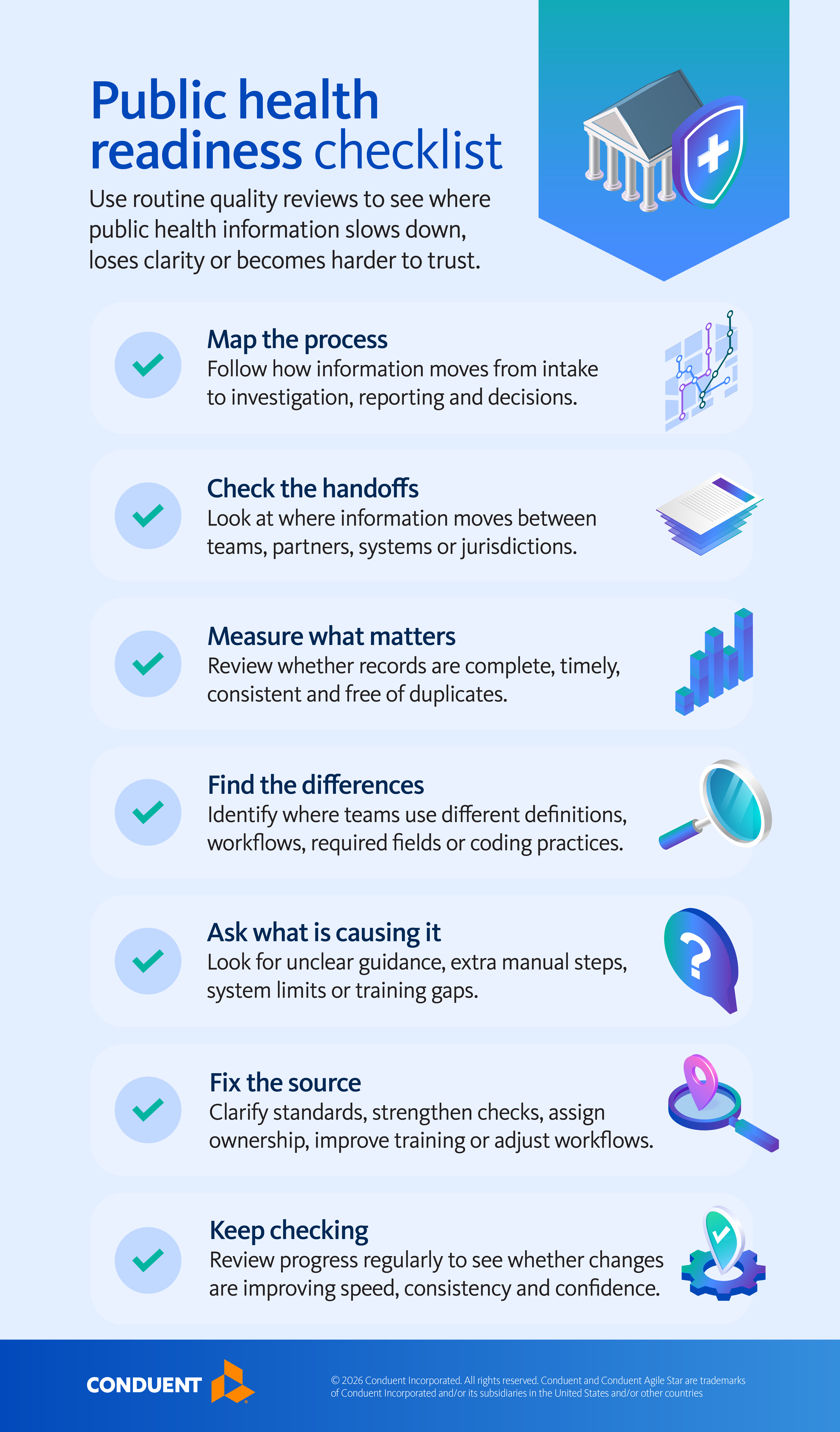
For agencies, the most useful starting point is often not a major system replacement or a broad modernization initiative. It is a clear-eyed assessment of where quality breaks down in daily operations.
Agencies can begin by examining the points where information is most likely to lose clarity, completeness or consistency. Are required fields being completed at the point of entry? Are case definitions understood the same way across programs? Are reporting timelines visible to the people responsible for meeting them? Are data quality issues identified early, or only after they affect analysis and reporting?
These questions help move quality from a general aspiration to a practical management discipline. They also make improvement less abstract. Instead of asking teams to “improve data quality,” agencies can focus on specific operational issues: incomplete demographic fields, inconsistent coding practices, delayed partner reporting, duplicate records, unclear workflow ownership or limited visibility into system performance.
Related: Public health needs a smarter path to optimization
Turning insight into improvement
Meaningful change happens when agencies connect data to the people, processes and technologies that shape the work. A dashboard may show that certain records are incomplete, but improvement requires understanding why. Is the field unclear? Is the workflow too burdensome? Is training inconsistent?
This is where quality infrastructure becomes actionable. Governance groups can clarify standards and decision rights. Program leaders can align workflows across teams. Training can reinforce definitions and expectations. Technology teams can adjust validation rules, prompts or reporting views. Performance measures can show whether the changes are working over time.
Creating the conditions for adoption
Agencies build stronger adoption by connecting quality work to the outcomes staff already care about: faster investigations, fewer manual corrections, clearer reporting, better visibility into community needs and greater confidence in decisions. When teams see how quality practices reduce rework and support better public health action, improvement becomes easier to sustain.
The most effective agencies also make quality visible. They review measures regularly, discuss issues openly and use findings to guide practical changes. Visibility creates accountability, but it also creates learning. Teams can see what is improving, where additional support is needed and how their work contributes to broader public health performance.
Related: The infrastructure gap holding back public health outcomes
From quality practice to public health performance
For public health agencies, progress depends on turning quality from a concept into a sustained practice. That means evaluating where variation occurs, aligning people and processes around common standards, using technology to reinforce the work and creating feedback loops that support continuous improvement.
That is where experienced partners can help without making quality feel like another administrative burden.
Conduent supports public health programs with technology and operational expertise that help agencies manage complex surveillance, case management and reporting environments. Platforms including Maven® Public Health Solutions support structured workflows, data capture and program visibility so teams can improve consistency and act with greater confidence.
How Maven supports stronger public health quality infrastructure
Built for public health programs, Maven supports the workflows, visibility and interoperability agencies need to reduce variation, improve consistency and act with greater confidence.
Maven helps agencies:
- Standardize complex workflows with configurable, disease-specific processes that help teams apply case management, investigation and reporting practices more consistently.
- Improve speed and visibility by supporting rapid case tracking, outbreak management, contact tracing and reporting across programs, partners and jurisdictions.
- Strengthen data quality at the source through structured data capture, rules-based workflows, automated checks and configurable requirements that help reduce incomplete or inconsistent records.
- Support better decision-making with embedded analytics, reporting, GIS tools, geocoding and data visualization capabilities that help agencies identify trends, exposures and emerging issues.
- Improve interoperability through integration with healthcare providers, clinics, laboratories and public health organizations, including HL7 messaging, ELR and ongoing data sharing with the CDC as needed.
- Adapt as needs change with no-code configuration for workflows and rules, prebuilt modules and a fully managed SaaS platform designed to scale during unexpected surges.
- Protect sensitive information with role-based access, multi-layered authentication and compliance support aligned with NIST, FedRAMP, HIPAA and ISO 27001 standards.
- Support broad public health programs across disease surveillance, outbreak management, environmental health, foodborne illness complaints, vital records, lead registries, opioid surveillance, refugee health and other use cases.
The value is not simply that Maven helps agencies manage more data. It helps public health teams make the work more consistent, visible and sustainable, so quality becomes part of daily operations rather than a burden added during moments of urgency.
The larger point is not about any single system. It is about helping agencies build operational conditions for faster, clearer and more accountable public health action.
Public health officials are judged in moments of urgency. Strong quality infrastructure helps ensure they are not forced to build the foundation for response after those moments have already arrived.
Ready to turn public health data into faster, more informed action? See how Maven helps agencies strengthen surveillance, streamline case management and safeguard communities worldwide. learn more now at https://www.conduent.com/government-solutions/medicaid-public-health-solutions/public-health-management-solutions/.