The future of government is online. Millions of people aren't.
For many residents, the new front door to government doesn't have a handle.
Throughout my career in health and human services, I've watched agencies work tirelessly to remove barriers to care, benefits and support services. Today, those efforts are focused not just on expanding access, but also on transforming how services are delivered.
Residents increasingly expect services to be available online, on demand and from any device. Agencies are responding by investing in self-service portals, mobile applications, digital communications and AI-enabled support tools that improve efficiency and create a more convenient experience.
But modernization creates a new responsibility. Every time we move a service online, we have to ask a simple question: Who might now have a harder time accessing it?
About 16% of U.S. adults rely on a smartphone for internet access and do not have broadband service at home, according to Pew. Among adults with household incomes below $30,000, the rate is substantially higher.
Likewise, rural Americans remain less likely than urban and suburban residents to have broadband access and are more likely to report internet connectivity challenges.
For agencies pursuing digital transformation, these are reminders that services must be designed for the realities of the populations they serve, not the technology assumptions they make.
Related: If people can’t use it, it doesn’t work: A guide to government usability
Access isn't the same as inclusion
When we talk about the digital divide, the conversation often centers on internet access. While connectivity remains important, digital inclusion is about much more than whether someone can get online.
I've seen agencies launch new digital services and celebrate adoption rates, only to discover that some residents were still struggling to complete applications, submit documentation or access critical information. The challenge wasn’t necessarily whether they had a device. It was whether the service was designed around how people actually use their smartphones or Lifeline phones to access government services.
Many government systems were originally designed for a desktop-first world. When agencies carry those assumptions into modernization efforts, they can unintentionally create barriers for residents who rely exclusively on smartphones to access services.
Access alone does not guarantee successful engagement.
Related: Case study: Building stronger Medicaid data operations
The residents most at risk
In health and human services programs, the residents most at risk of being left behind are often the same populations agencies are working hardest to support.
Older adults, adults with disabilities and low literacy may struggle with unfamiliar technology, authentication requirements or complex navigation. Individuals with disabilities may encounter systems that technically meet accessibility requirements but remain difficult to use in practice. Residents with limited English proficiency may face challenges understanding instructions, program requirements or available resources.
Rural communities continue to experience connectivity limitations. Lower-income households may rely on shared devices or limited data plans. Individuals with lower levels of digital literacy may need additional support navigating processes that others take for granted.
These barriers can have consequences. When residents encounter obstacles accessing Medicaid, nutrition assistance, developmental disability services, behavioral health services or other programs, the impact extends far beyond the technology itself. Delays in accessing services can affect health outcomes, financial stability and overall well-being.
Related: In government, the era of “please hold” may soon be over
Measuring what matters
One of the biggest opportunities agencies have is rethinking how they measure the success of modernization efforts.
Too often, success is defined by channel migration. More online transactions. More portal users. Fewer calls to the contact center. Those metrics provide valuable insight, but they don't tell the whole story.
The more important question is whether residents are successfully receiving the services they need.
An agency can achieve impressive digital adoption numbers while still creating barriers for vulnerable populations. Conversely, an agency that combines digital convenience with strong accessibility features, multilingual support and alternative service channels may achieve better outcomes even if some residents continue to rely on phone or in-person assistance.
Modernization should not be measured solely by how many people move online. It should be measured by how effectively agencies improve access to services.
If I could redesign one thing
Eligibility serves as the front door to many of the most important services government provides. Yet it remains one of the most complex experiences residents encounter.
Many individuals must navigate multiple programs, provide the same information repeatedly, submit documentation through different systems and interpret complicated eligibility requirements. For families already experiencing financial hardship, housing instability or health challenges, every additional step or challenge increases the likelihood that an application will be delayed or abandoned.
Agencies often organize these processes around programs and departments. Residents organize their lives around needs.
A parent seeking healthcare coverage, nutrition assistance and childcare support shouldn't have to understand how agencies are structured to access those services.
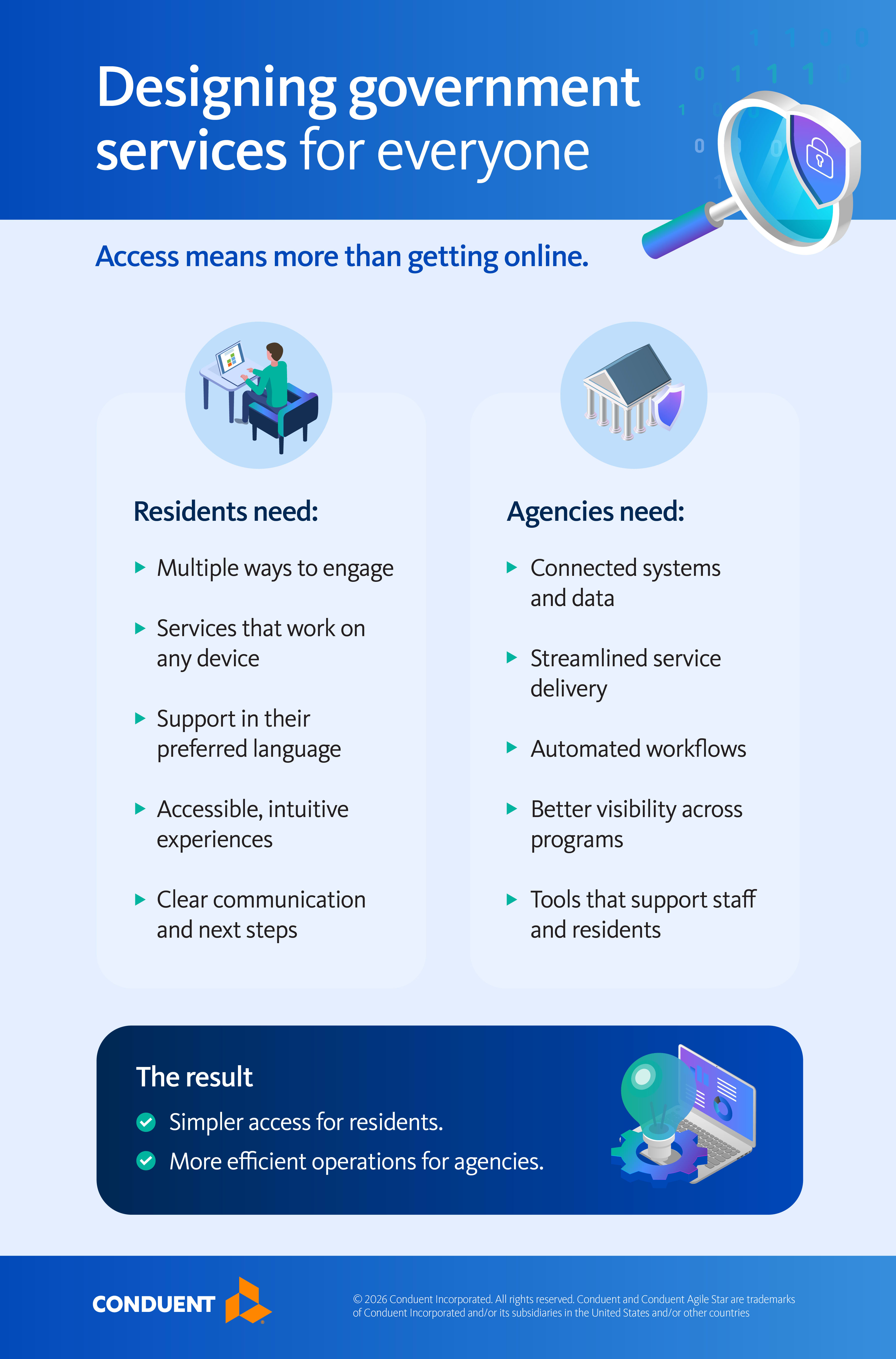
Instead, agencies should work toward a more unified, resident-centered experience. Imagine a process where residents answer a series of plain-language questions through a mobile device, contact center or community partner. The system identifies potential eligibility across programs, guides residents through documentation requirements, provides assistance in their preferred language and proactively communicates next steps.
Behind the scenes, integrated systems, workflow automation and intelligent decision support can help agencies reduce administrative burden while improving accuracy and consistency.
The result is a better experience for residents and a more efficient operation for agencies.
A better test of modernization
Digital transformation will continue to shape the future of government services. The question is no longer whether agencies should modernize, but how they can modernize in ways that expand access for everyone.
The most successful agencies will recognize that accessibility, digital inclusion and health equity are not separate initiatives. They are fundamental to delivering effective public services.
Technology should help agencies meet residents where they are. It should make services easier to access, easier to understand and easier to navigate.
At the end of the day, the true measure of modernization isn't how advanced the technology becomes. It's whether more people can successfully access the services they need to live healthier, more stable lives.
That's the outcome that matters most.
To learn how person-centered intelligence, automation and AI can support your modernization goals, connect with our team and explore what’s possible. Learn more now at-https://www.conduent.com/government-solutions/.