Big results in finance AI start with one focused step
Finance has invested heavily in ERP systems, automation and analytics. Yet teams still spend considerable time managing exceptions, investigating discrepancies and reconciling information across disconnected processes. The challenge is turning technology investment into measurable business improvement.
As AI adoption accelerates, CFOs face a sharper question: What is changing in the work itself — and how will finance professionals verify the value?
According to Gartner, 59% of finance leaders report using AI, yet only 7% of CFOs report high or very high impact. Organizations further along in AI maturity are nearly three times more likely to report high impact. While maturity doesn't guarantee results, the findings suggest that how organizations put AI to work matters.
The next step is not necessarily more investment, but more focus.
The ambition is clear. The readiness gap is real.
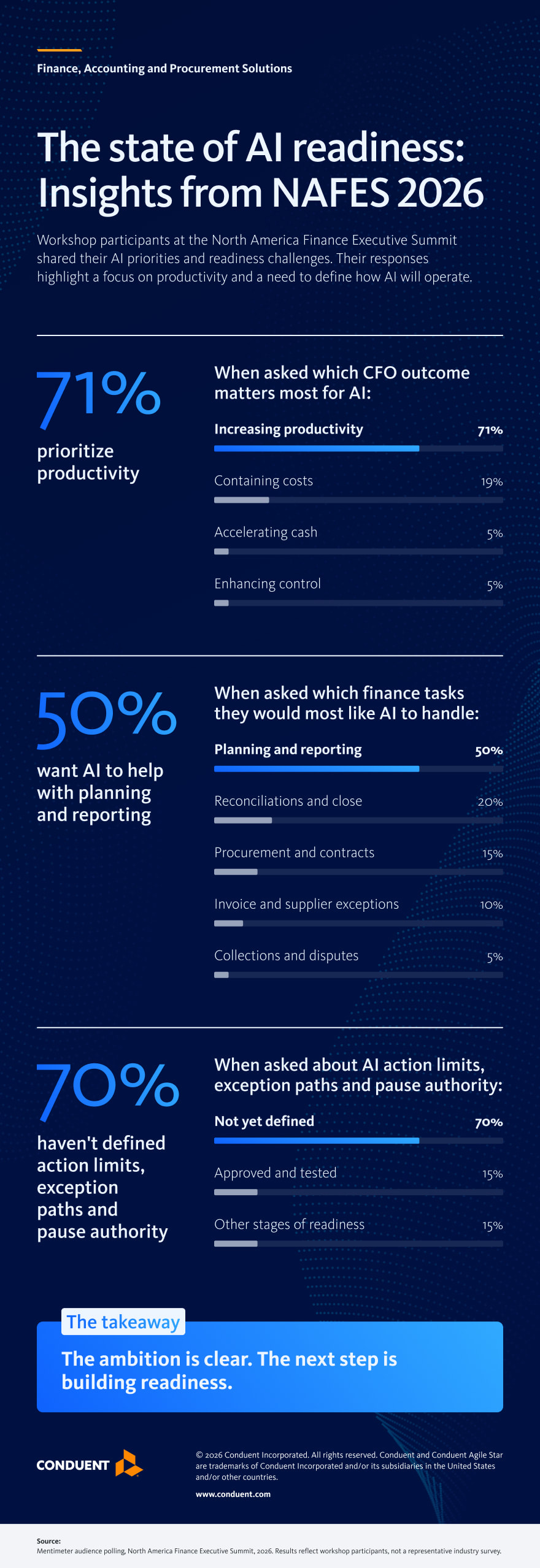
At the 2026 North America Finance Executive Summit (NAFES), Conduent experts asked finance leaders where they most wanted AI to make a difference.
Seventy-one percent identified productivity as their top priority, while planning and reporting emerged as the most frequently selected tasks for AI automation.
But another finding exposed a critical obstacle: 70% said their AI agents' action limits, exception paths and pause authority had not yet been defined.
Finance leaders know what they want AI to accomplish, but not necessarily what they will authorize it to do. Moving from task automation to decision-making requires explicit boundaries, accountable owners and clear paths for human intervention.
Start small. Prove value. Then expand.
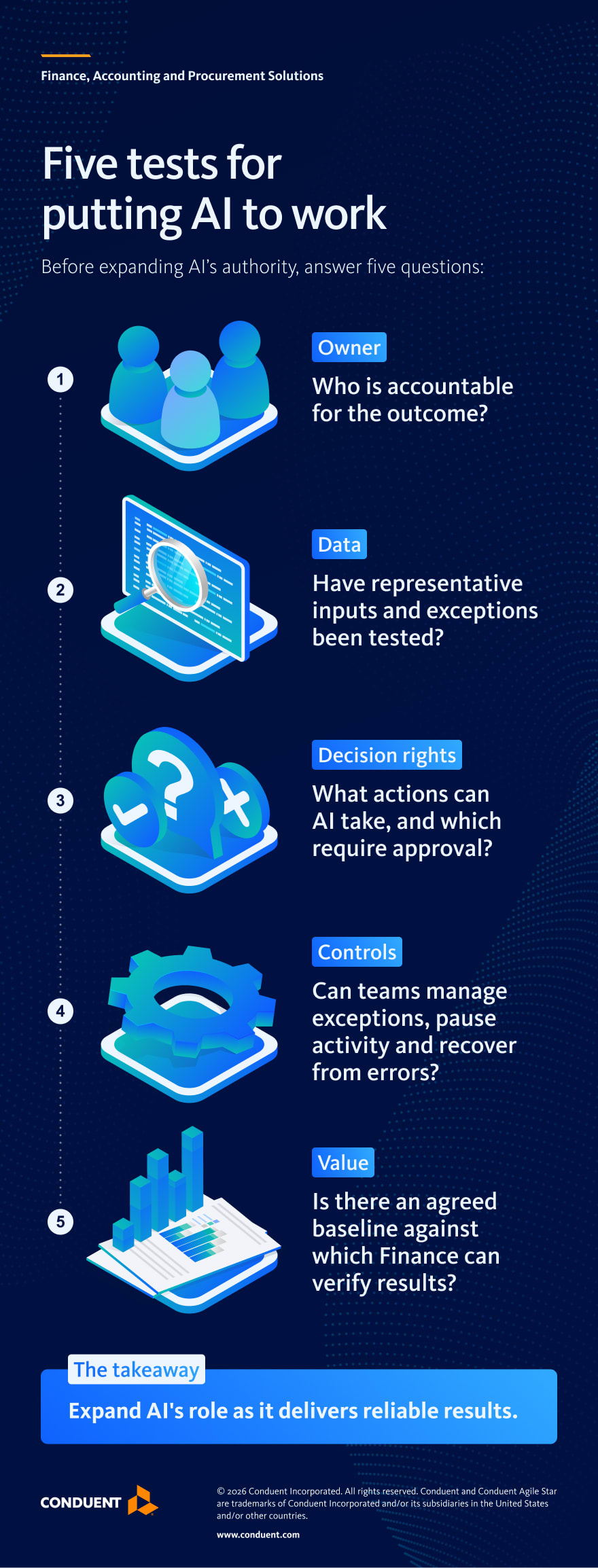
Start with one workflow and one measurable outcome rather than an entire department. Define the boundaries, test the approach and verify the results before expanding AI’s authority.
Consider collections. AI can prioritize accounts, gather supporting information and recommend next actions, while people retain authority over disputes, credit decisions and payments. Finance can then compare results with an agreed baseline.
The same approach applies to invoice exceptions, account reconciliations and procurement activities, where manual intervention can increase costs, delay cash flow and consume valuable staff capacity.
Conduent's FastCap® Spend Analytics demonstrates the potential value of identifying these opportunities. Since 2021, FastCap has reported more than $900 million in client value. In individual engagements, analysis identified $6 million in supplier optimization opportunities for a logistics client and $3 million in potential savings for an automotive client. FastCap is Conduent’s AI-powered financial leakage and working-capital optimization solution. It combines advanced analytics, machine learning, GenAI and Agentic AI with finance expertise to identify, recover and prevent value leakage across accounts payable and procurement, including duplicate and erroneous payments, contract noncompliance, supplier spend and other hidden savings opportunities.
Make the next investment count
Conduent's Finance, Accounting and Procurement Solutions help organizations address the manual work between existing finance platforms and business outcomes. Combining intelligent automation, analytics and human expertise, Conduent helps turn opportunities into controlled action across finance workflows.
The goal is not to automate everything at once. It is to establish trust in one workflow, demonstrate value and expand authority only when the evidence supports it.
Which finance workflow will you improve first?
Schedule an assessment with a Conduent expert to identify a workflow, define its potential value and establish the evidence needed for a controlled test. Contact us to get started, or learn more.