How better-connected data strengthens public health response
Around the world, public health agencies are under increasing pressure to detect threats earlier, respond faster and make better use of the data already flowing through their systems. Emerging disease threats, greater population mobility, growing data volumes and rising expectations for timely reporting are making speed and accuracy more important than ever.
Yet the information agencies rely on often remains fragmented across healthcare providers, laboratories and public health systems. That fragmentation can limit the value of investments in cloud platforms, APIs, advanced analytics and artificial intelligence.
Those technologies can strengthen surveillance and decision-making, but they depend on something more fundamental: data that can move reliably across systems and retain its meaning along the way.
That requires a strong technical and semantic backbone, including common exchange standards, terminologies and validation practices that help healthcare providers, laboratories and public health agencies share information accurately and consistently.
Related: Public health is only as strong as its data
Better decisions begin with better-connected data
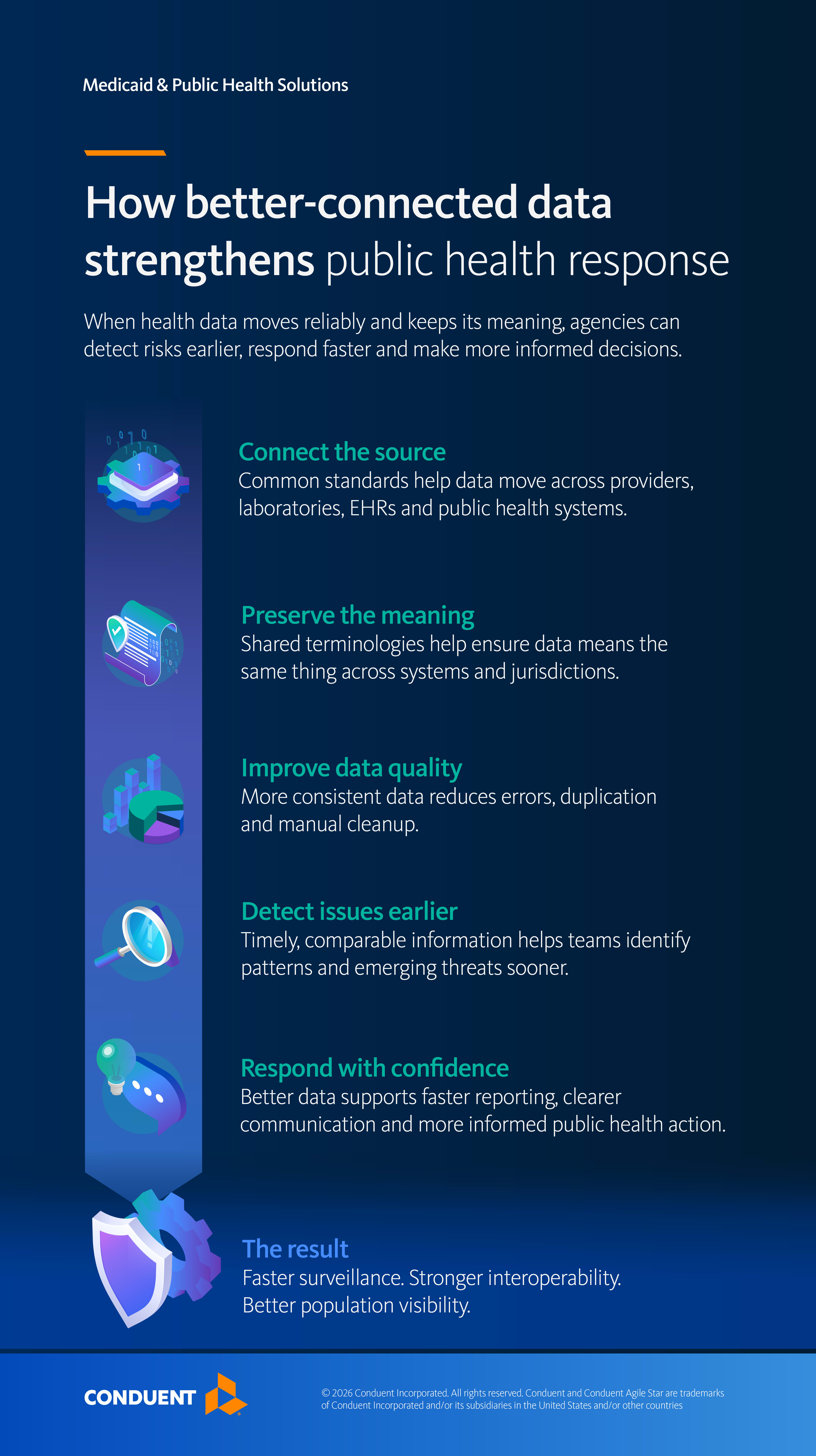
Public health surveillance depends on information arriving from many different sources, including healthcare providers, laboratories, electronic health records and other government systems.
Technical standards including HL7 and FHIR provide common structures and exchange mechanisms that help information move between those environments. Without them, agencies can be left managing one-off interfaces, manual processes and workarounds that are expensive to maintain and difficult to scale.
Shared standards can reduce that complexity. They can also support more automated exchange, helping information reach public health teams faster and with less manual intervention.
But getting data from one system to another is only part of the challenge.
Moving data isn’t enough
Information can arrive successfully and still be difficult to use. Consider laboratory results submitted by multiple healthcare organizations. If each organization describes the same test differently, analysts may need to interpret and map those results before they can be compared.
Semantic standards including LOINC and SNOMED CT help establish consistent meaning by standardizing how laboratory tests, clinical concepts and observations are represented.
That consistency makes data easier to aggregate, compare and analyze across providers and jurisdictions. It also reinforces an important distinction: interoperability isn’t simply the ability to exchange information. It’s the ability to exchange information that can be understood and used when it arrives.
Related: When public health data crosses borders: Navigating standards and reporting pathways without losing
When time matters, consistency matters
The impact becomes especially clear during an emerging public health event.
Imagine laboratories begin reporting an unusual increase in positive results for a respiratory pathogen. When those results use consistent terminology and arrive through standardized reporting mechanisms, surveillance systems can aggregate the information quickly and epidemiologists can identify an emerging pattern.
If the information arrives inconsistently, the signal may take longer to recognize and validate.
That delay matters. During routine operations, it creates inefficiency. During an outbreak or other public health threat, it can make it harder to identify patterns early, coordinate a response and communicate a clear picture of what’s happening.
Modernization has to start below the dashboard
Public health modernization is often associated with visible technologies: new applications, dashboards, analytics platforms and cloud environments. Those investments are important. But moving fragmented or inconsistent data into newer technology can simply carry old problems into new environments.
Modernization also has to address the standards underneath those systems.
Common technical and semantic standards can support more automated data exchange, simplify the addition of new data sources and reduce dependence on manual processes. They can also create the conditions needed for more advanced capabilities.
Analytics, automation, early-warning systems and AI all depend on data that’s sufficiently complete, consistent and understandable.
The intelligence agencies expect from modern technology depends heavily on the quality of the information feeding it.
Related: Empowering breast cancer awareness with data-driven innovation
Consistency can improve visibility across populations
Standardization can also help leaders better understand what’s happening across the communities they serve.
Consistently captured demographic, clinical and geographic information makes it easier to compare outcomes and identify differences in areas such as disease burden, vaccination rates and access to services.
When information is incomplete or recorded differently across sources, important patterns can be harder to see.
Standards alone don’t create better or more equitable health outcomes. But more complete and comparable data can give leaders a clearer view of where needs exist and support better-informed decisions about outreach, interventions and resources.
Treat standards as a strategic capability
For agency leaders, interoperability standards shouldn’t be viewed solely as an IT concern or technical plumbing to address late in a modernization effort.
When systems are easier to connect and data is easier to trust, public health professionals can spend less time resolving inconsistencies and more time interpreting information and acting on it.
The goal isn’t simply to move more data or deploy more technology. It’s to make sure the right information reaches the right people, with the right meaning, quickly enough to support better public health decisions.
Discover how Conduent helps public health agencies strengthen disease surveillance, improve data quality and support faster, more informed response with Maven Public Health Management Solutions.
Learn more now at www.conduent.com/government-solutions/medicaid-public-health-solutions/public-health-management-solutions/.