What happens when public agencies put AI to work?
Behind the scenes of government’s AI awakening
A decade or two ago, author and publisher Tim O’Reilly wrote that government should be more than a “vending machine” that delivers services in exchange for taxes. Its greater potential, he said, lies in functioning as a platform, creating the infrastructure and standards that enable better outcomes for residents at larger scale.
For public agencies, that means aspiring to go beyond transactional service toward smarter and more connected operations.
Today, AI is accelerating that aspiration. The question is no longer whether AI belongs in public service, but how agencies can deploy it responsibly, securely and in ways that strengthen operational performance and public trust.
AI and the future of public administration
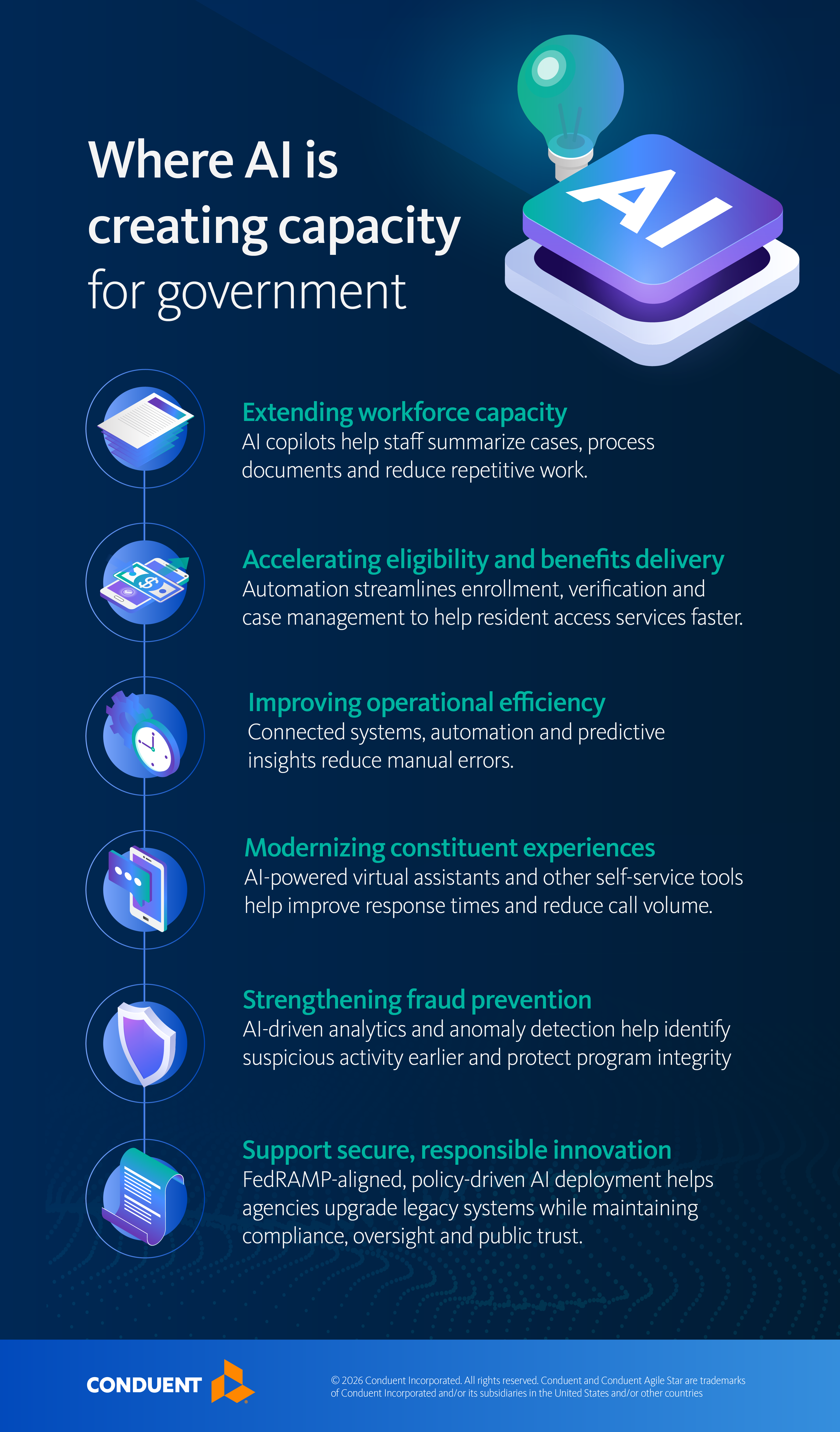
For state and local leaders, generative AI presents a significant operational opportunity. AI copilots can help case workers summarize records, navigate data, automate document processing and reduce repetitive administrative burdens that have long strained agency capacity.
Having led health and human services operations firsthand, I know how quickly staffing shortages, rising caseloads and growing constituent expectations can strain even the most dedicated agencies. In that environment, AI tools offer more than innovation. They provide a practical way to extend workforce capacity, reduce administrative burden and help public servants deliver the level of service residents increasingly expect.
The greatest promise lies not in replacing public servants, but in honoring their commitment by extending their capacity to serve more effectively.
Government AI moves from conversation to action
When properly deployed, generative AI can accelerate call center response times, improve constituent self-service, streamline case notes, detect fraud and reduce manual errors across eligibility, benefits administration and fraud detection workflows.
For agencies managing complex programs including Medicaid, SNAP, child support or public health operations, these efficiencies can materially improve both service delivery and workforce resilience.
Yet AI adoption in government carries far higher stakes than private-sector experimentation.
Public agencies must operate within strict compliance, accessibility and ethical frameworks. Section 508 accessibility, FedRAMP-authorized cloud environments, NIST AI Risk Management Framework guidance, data privacy mandates and human oversight requirements all shape how these technologies can be used.
In practice, this means generative AI cannot function as an unchecked decision-maker. It must serve as an assistive layer, with transparent governance and defined boundaries.
Related: Webinar: How government agencies can fight fraud, waste and abuse with AI-driven strategies
Government’s AI future extends beyond chatbots
Increasingly, agencies are evaluating sovereign AI strategies, including domestically developed or nationally hosted large language models designed to meet stricter security, data residency and policy requirements.
And as geopolitical competition and technology nationalism expand, governments are becoming more cautious about where AI models are trained, hosted and governed.
For state and local procurement teams, this changes how AI vendors are evaluated. Agencies need to consider where systems are hosted, how data is governed, whether providers meet domestic compliance requirements and how much operational control they retain. As a result, many agencies may prioritize secure, flexible AI solutions that integrate into existing systems over large-scale deployments that require disruptive replacement.
For experienced public-sector leaders, this approach should feel familiar.
Incremental AI transformation over disruptive replacement
The most successful upgrade efforts rarely come through wholesale transformation. They emerge through disciplined, incremental improvements that reduce friction while preserving continuity.
Generative AI should be approached the same way.
The opportunity is substantial: stronger staff productivity, faster constituent support, reduced administrative overhead and better operational insight. But these gains will only be sustainable if agencies pair innovation with governance.
In the years ahead, public-sector AI leadership will depend on balancing ambition with restraint.
The agencies that succeed will not be those that deploy AI fastest. They will be those that deploy it most responsibly, aligning automation with policy, ethics and constituent trust.
For government, the future of AI is not simply smarter technology.
It is technology deployed with public purpose, operational discipline and democratic accountability at its core.
Ready to modernize how your agency serves?
Explore how Conduent helps government organizations improve service delivery, strengthen program integrity and reduce operational friction with secure, AI-driven solutions built for real public sector performance. Learn more
Related solutions
- AI-enabled constituent experience and contact center modernization
- Eligibility and enrollment transformation
- Fraud, waste and abuse prevention solutions
AI built for real government work
At Conduent, we apply AI to solve practical government challenges, from improving constituent interactions to streamlining service delivery and accelerating access to critical benefits. As AI capabilities evolve, we are building on years of proven deployment to help agencies expand capacity, improve efficiency and deliver stronger public outcomes.
Learn more about Conduent’s commitment to AI-powered solutions