AI is here. Can Medicaid systems keep up?
States are finding out what flexibility really requires.
One thing I keep coming back to is how quickly the Medicaid environment is changing, and how difficult it can be for state systems to keep pace.
New federal requirements, shifting eligibility and payment policies, growing compliance demands and cybersecurity risks are all putting more pressure on agencies. At the same time, states are being asked to strengthen program integrity and improve service delivery without disrupting programs that millions of people rely on.
While attending MESC earlier this summer, I had the chance to hear how state Medicaid leaders are thinking about these challenges firsthand. What struck me was how consistently the same pressures surfaced: systems that need to change faster, data that needs to be more accessible and trustworthy, growing interest in practical uses of AI, and the very human challenge of managing change across complex organizations.
It reinforced something I’ve been thinking about for a while. The conversation can’t just be about replacing old technology with newer technology. The more important question is whether states have the flexibility to respond as Medicaid itself keeps changing.
Related: Medicaid work and community engagement compliance for 2027
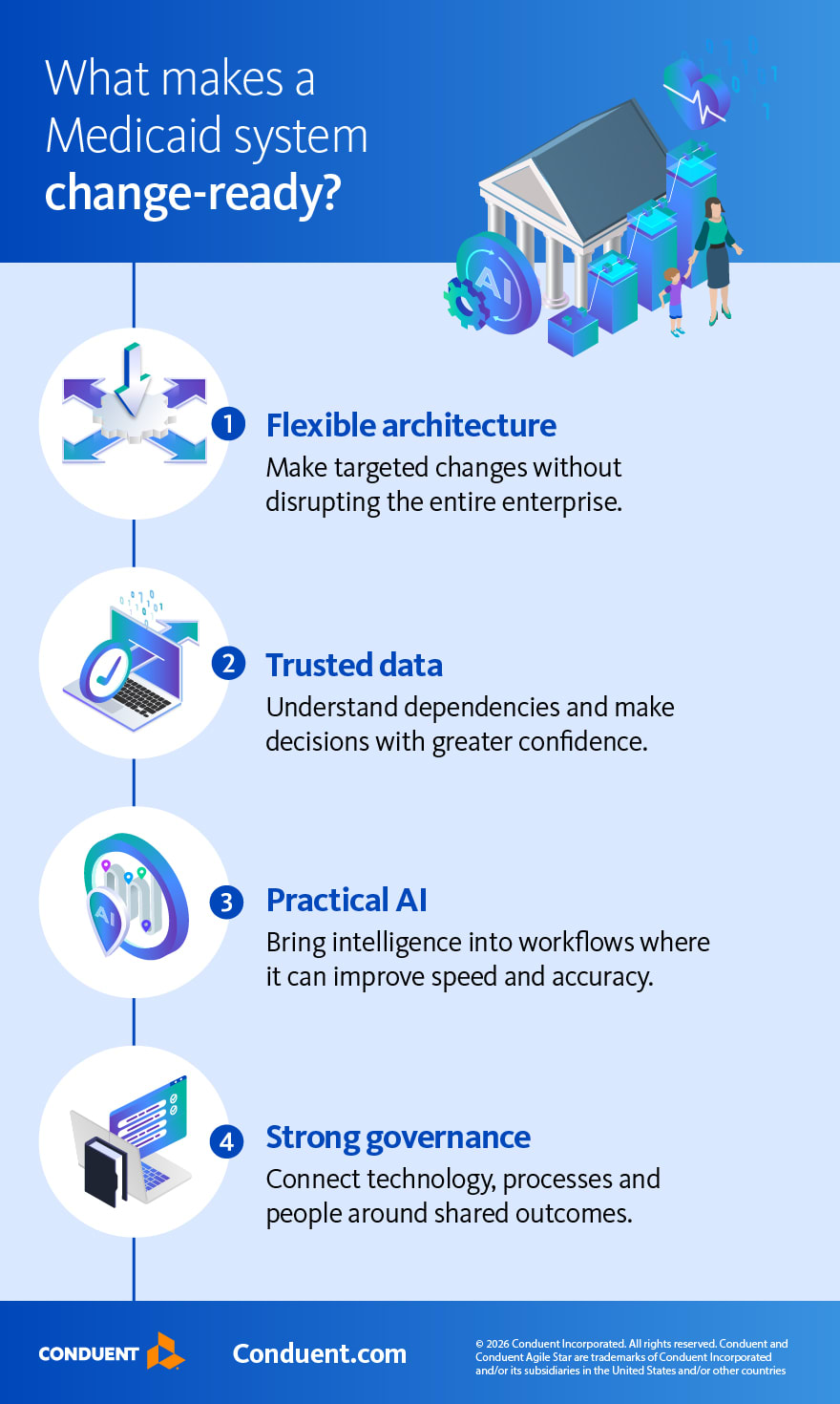
Flexibility starts with architecture
Large, tightly connected systems can make even targeted changes difficult. More modular approaches give states greater control over how individual capabilities evolve.
At MESC, leaders from Colorado and New Mexico shared how their states are building more flexible Medicaid enterprises. Colorado, for example, has broken its enterprise into distinct modules that can be improved and integrated without large-scale disruption. New Mexico has taken a similar approach, establishing a flexible foundation through its Turquoise Claims system.
The benefit is not modularity for its own sake, but the ability to respond faster, introduce new capabilities more selectively and reduce the risk that one change creates unintended consequences elsewhere.
Even within a specific module, vendors need to build their architecture in a plug and play microservices architecture to allow flexible change, maximum operational efficiency and seamless data integration
Related: AI - Powered Medicaid Service Authorization Module
Data makes faster change possible
Flexibility also depends on whether agencies can access and trust their data.
Strong governance, clearer data lineage and better visibility across the Medicaid enterprise help states understand dependencies before making changes. They can also support more accurate reporting, stronger program integrity and better-informed operational decisions.
That foundation will become increasingly important as states respond to changing eligibility requirements, payment accuracy expectations and other compliance pressures.
When agencies know where their data comes from, how it moves and how it is being used, they are better positioned to act with confidence.
AI is moving closer to the work
Artificial intelligence is also becoming more practical.
States are exploring AI for fraud and waste detection, eligibility quality assurance, knowledge assistance, documentation summarization, policy interpretation and case review. Increasingly, the opportunity is to embed those capabilities directly into existing workflows.
That can help employees identify inconsistencies earlier, find relevant information faster and focus attention on cases requiring judgment.
The goal should not be to add AI wherever possible. It should be to apply it where it can make work faster, more accurate or more manageable.
Related: Case study: Helping a state Medicaid agency streamline eligibility and improve outcomes
From detection to prevention
That same thinking is changing approaches to program integrity. Analytics and AI can help agencies move further upstream, identifying potential issues before payments are made or errors become more difficult to correct.
For states facing greater scrutiny around payment accuracy and eligibility, the ability to intervene earlier can reduce risk while making better use of limited staff resources.
Technology enables change. But people make it work.
Even the most flexible platform cannot succeed without strong governance and organizational change management. States need clear accountability, communication across stakeholders and partnerships built around shared goals. Employees need to understand what is changing, why it matters and how new tools fit into the work they already do.
How quickly can your Medicaid systems respond to what changes next?
See how Conduent can help build more flexible, data-driven Medicaid operations designed to adapt as policies, priorities and technologies evolve. Connect with an expert now by visiting www.conduent.com/government-solutions/medicaid-public-health-solutions.