Why healthcare decisions take longer than they should
The work is waiting
Not long ago, I was talking with a healthcare executive about the challenges her organization was facing.
Like many leaders, she wanted more visibility, better insights and a clearer understanding of what was happening across the business.
That sounded reasonable.
But the more we talked, the more it became clear that information wasn't the problem.
The real challenge was everything that had to happen before information could be turned into action.
For modern healthcare organizations, the volume of work is immense. Nearly 9 billion healthcare claims are processed in the United States each year. Behind those claims sits an even larger ecosystem of transactions, correspondence, supporting documentation and administrative activity moving among providers, payers and members. The result is a healthcare system that spends more than $1 trillion annually on administration. At that scale, even small inefficiencies have outsized consequences. Every additional review, handoff or request for information introduces delay, creating work for organizations and waiting for the people they serve.
In our experience working with healthcare enterprises, the process often works like this: A claim arrives. An appeal is submitted. A member sends supporting documentation. Each contains information needed to move a decision forward. Yet before action can occur, that information must be reviewed, interpreted, validated and routed to the appropriate team. As it moves through queues, handoffs and systems, delays accumulate at each step.
Because this work is embedded in everyday operations, most organizations barely notice it. Yet it consumes an extraordinary amount of time and attention. Teams spend hours preparing information for decisions rather than making decisions themselves.
That distinction matters. Organizations often view operational delays as a technology problem or a workflow problem. In many cases, however, the greater constraint is the distance between information and action. The challenge is not that organizations lack the information they need, it’s that too much effort is still required to transform information into something the enterprise can readily understand and act upon.
Every delay has a consequence. Decisions take longer. Providers wait longer for answers. Members wait longer for updates. What often appears to be an operational issue ultimately becomes an experience issue.
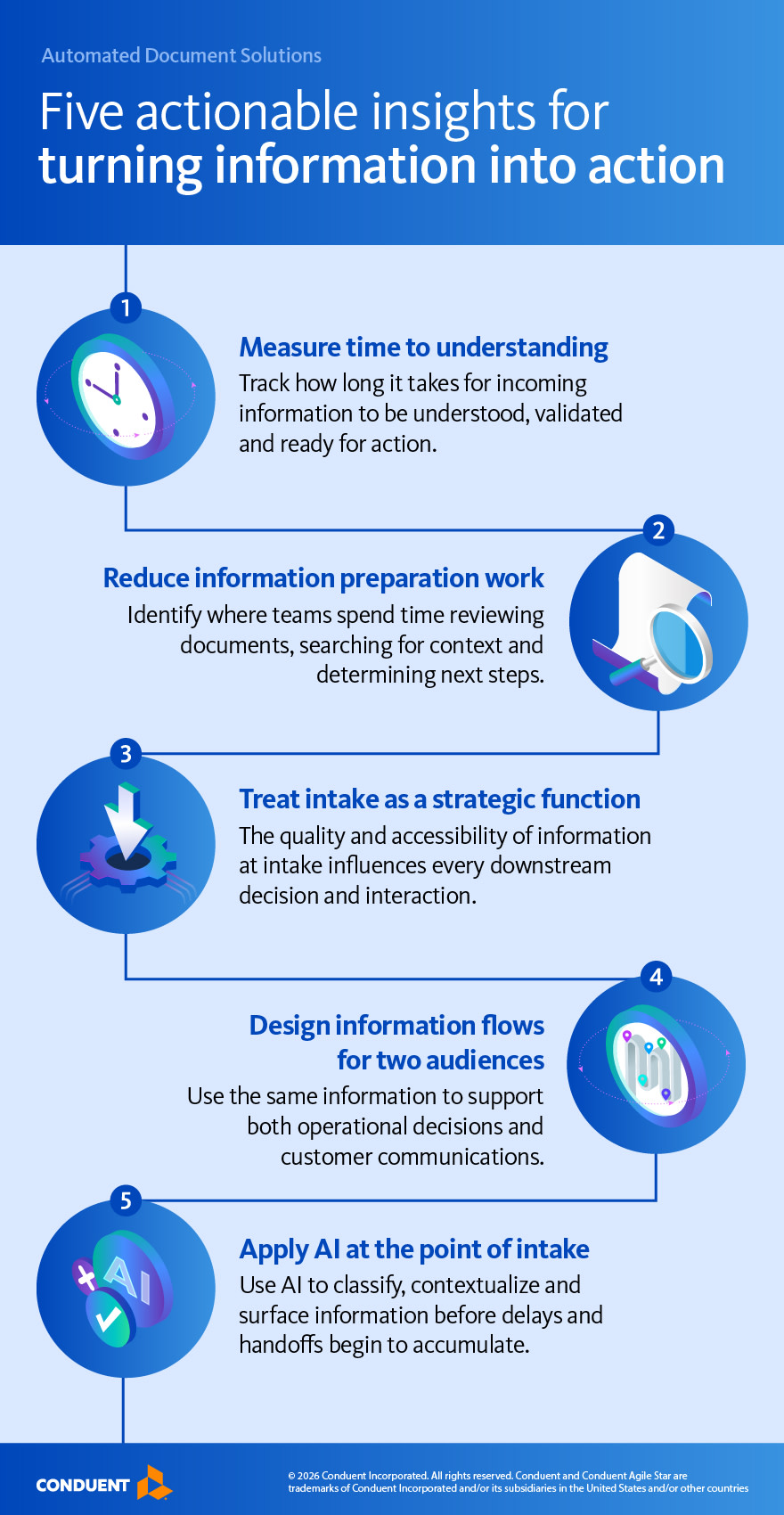
This may also explain why many organizations have struggled to realize the full value of AI. Too often, AI is applied after information has already been reviewed, routed and prepared for action. Yet some of the greatest opportunities exist earlier in the process. When organizations use AI to understand, classify and contextualize information at the point of intake, teams gain faster access to the insights needed to make decisions, serve customers and move work forward.
Related: From intake to intelligence: The next frontier in document automation
Why healthcare decisions take longer than they should
Historically, intake functions were designed to capture documents and route work. Success was measured by throughput and processing efficiency. Today, however, organizations face a different set of expectations. Customers want timely updates, seamless experiences and proactive communication. At the same time, organizations must improve productivity and manage costs.
These goals are increasingly interconnected.
As a result, leading organizations are beginning to view intake not as an administrative function, but as the point where operational decisions begin. The objective is no longer simply to move information through a workflow. It is to make information immediately useful.
When information is understood earlier in the process, organizations can reduce manual effort, accelerate decisions and improve visibility across teams. More importantly, they can respond to customers with greater speed and confidence.
From processing work to orchestrating action
This is where organizations are beginning to separate themselves. For decades, operational excellence was largely defined by the ability to process work efficiently. Success was measured by throughput, turnaround times and the number of tasks completed.
Today, a different model is emerging.
Advances in intelligent document processing, AI-enabled content understanding and workflow orchestration allow organizations to identify intent, surface critical information and initiate action much earlier in the process. Instead of waiting for information to be manually reviewed, interpreted and routed, organizations can make that information available at the moment it enters the enterprise.
The impact extends well beyond efficiency. The same information can support decision-making, customer communications, analytics, workflow automation and downstream systems simultaneously. Teams spend less time searching for information and more time acting on it. Customers spend less time waiting for updates and more time receiving them.
In this model, intake becomes more than an administrative function. It becomes the point where information begins creating value.
The organizations that gain the greatest advantage will not necessarily be those that process documents faster. They will be those that transform information into decisions, communications and outcomes with the least amount of friction. In an environment where speed, confidence and customer experience increasingly define success, the ability to turn information into action may be one of the most important capabilities an organization can build.
Related: Case study: Enabling business process transformation for a leading health plan
Making information work across the enterprise
This shift changes the role information plays within the enterprise. Information is no longer simply an input to be processed. It becomes a shared asset that can simultaneously support decision-making, customer communications, workflow orchestration and business intelligence.
For healthcare payers, the opportunity is clear. Every claim, appeal, form and member interaction contains information that can create value beyond a single transaction. The organizations that recognize this potential and design their operations accordingly will be best positioned to deliver the speed, confidence and experience that members increasingly expect.
At Conduent, we help healthcare organizations bridge the gap between information and action. By combining intelligent document processing, AI-enabled content understanding and workflow orchestration, we help payers make critical information available earlier in the process, enabling faster decisions, more effective operations and better member experiences.
The goal is simple: shorten the distance between information and action.