Government budgets are tightening. Demands are not.
State agencies entered 2026 under mounting fiscal pressure, shaped by slowing growth, rising demand and diminishing flexibility. State spending is projected to increase by just 1.3% in fiscal year 2026, with median growth effectively flat at 0.2%, according to the National Association of State Budget Officers’ Fiscal Survey of States. Revenue growth is even more constrained, expected to reach only 0.7%, leaving little room to absorb new costs or expand services.
Compounding the challenge, pressures are not confined to state budgets alone. The federal workforce declined by 10.3% in 2025, with hiring down 55.6% and separations up 80.8%, according to the Pew Research Center. As federal match rates tighten in some services and requirements expand in others, administrative and program strain continues to shift to state agencies.
These top-line figures reflect a broader shift. Nearly half of states anticipate flat or declining spending, while reserves built during the pandemic are being drawn down to close gaps. At the same time, revenue momentum has “considerably slowed,” and some states are already facing structural deficits, according to the National Conference of State Legislatures. The cushion that once allowed agencies to absorb shocks is thinning, just as operational demands continue to rise.
Related: How to make government services people can feel working
A more practical path forward
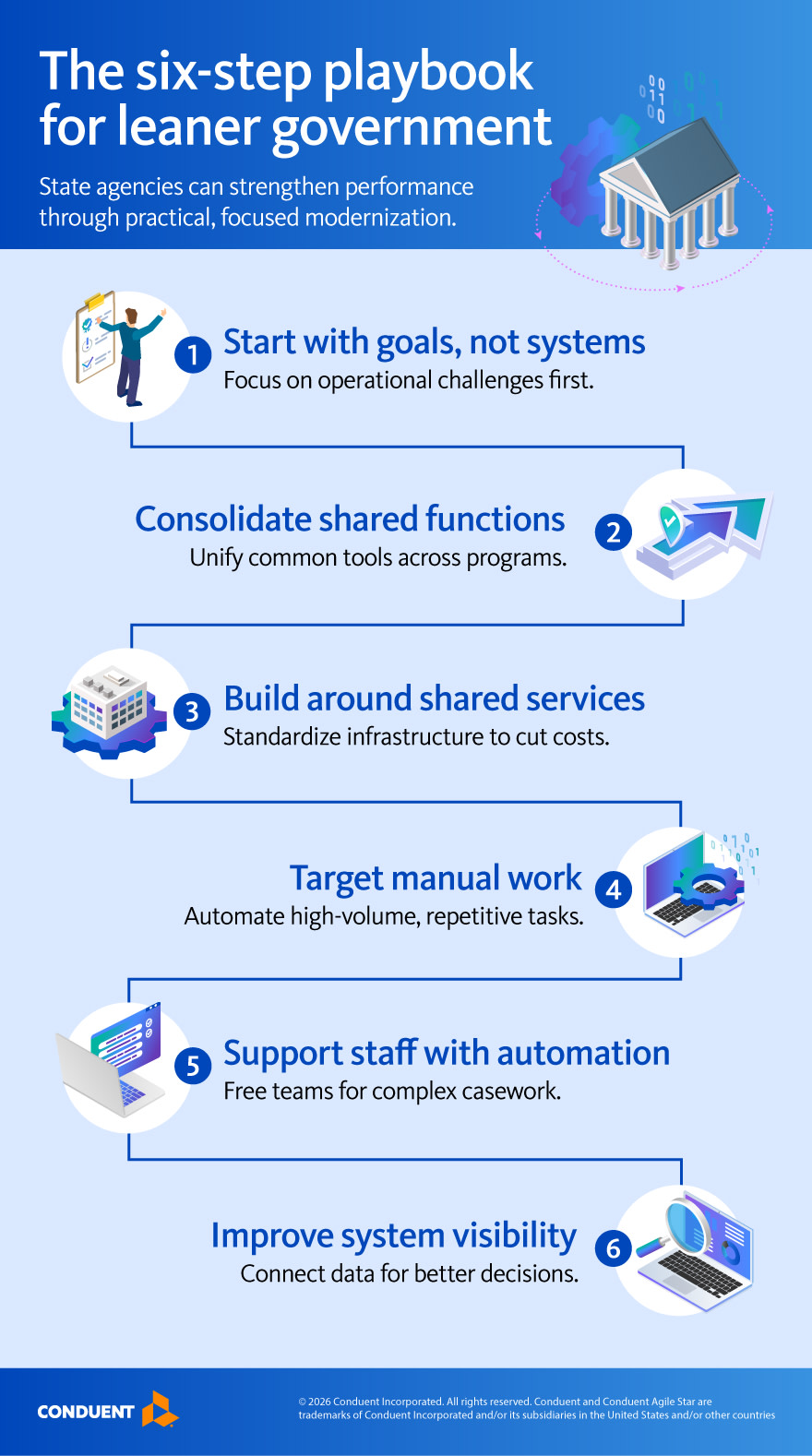
The 2026 budget landscape does not eliminate opportunity. It narrows the margin for error. Agencies that move forward will do so by focusing on what works. Incremental improvements. Shared platforms. Targeted automation. Clear, outcome-based funding strategies.
In a constrained environment, success is not about doing everything at once. It is about making the right moves, in the right order and ensuring every investment delivers measurable value.