In government, real change isn’t just a fresh coat of paint
We’re transforming, too. Here’s what we’re learning.
One takeaway from my years in public service is that meaningful change doesn’t happen under perfect conditions. Agencies can’t put critical operations on hold while replacing technology or introducing teams to new ways of working.
That challenge is especially clear when you look at the technology many agencies still rely on. The 11 federal legacy systems GAO identified as most in need of modernization are between 23 and 60 years old, and they cost about $754 million a year to operate and maintain. The goal for all federal, state and local agencies now is identifying how to improve systems without disrupting the services.
Change requires questioning what feels comfortable
Today, at Conduent, we’re going through a transformation of our own. We’re simplifying how we operate, sharpening accountability and bringing new ideas into the organization. Our ASCEND strategy reflects that focus by standardizing operations, specializing in areas where we can lead and scaling our go-to-market capabilities.
Our CEO, Harsha Agadi, has spoken about many of these changes through a client lens; clients want partners that can help them move faster, simplify complexity and deliver measurable outcomes.
I instruct my teams to walk our talk. The same practices we use to help our clients navigate change should guide our own transformation. That means testing new approaches, learning quickly and accepting that not every idea will work the first time. It also means honoring an organization’s history doesn’t require preserving every practice that came with it.
Going through change ourselves reinforces something I saw repeatedly in government: technology alone doesn’t transform an organization. People, processes, accountability and a clear understanding of the outcome all have to move together.
Related: Slow change is becoming Medicaid’s next big risk
Flexibility matters as much as technology
Nearly 80% of planned federal IT spending in FY2025, about $83 billion, was devoted to maintaining existing systems rather than developing new ones.
As my colleague Shanker Balakrishnan explored recently, transformation to solve this must consider whether systems, data and teams can adapt alongside policies, priorities and expectations. Often, that means finding ways to extend the capabilities of existing operations rather than replacing them.
In government payments, for example, we’ve combined AI with human expertise to expand fraud detection. In one deployment, a small team of specialists can now monitor tens of thousands of accounts for suspicious activity with significantly improved accuracy. The goal isn’t AI for its own sake, but giving people greater capacity to protect public resources and the individuals who depend on them.
We’re seeing the same principle in employee benefits. Conni, our intelligent assistant, resolved 86% of employee questions without an agent during the 2026 benefits open enrollment period, while reducing live-chat demand by 21%. That allows human experts to spend more of their time on situations where judgment and empathy matter most.
That, to me, is what meaningful transformation looks like. Not simply introducing something new, but redesigning work so that people can accomplish something better.
Related: What's next is now: Medicaid’s new chapter has begun
Transformation is something we do together
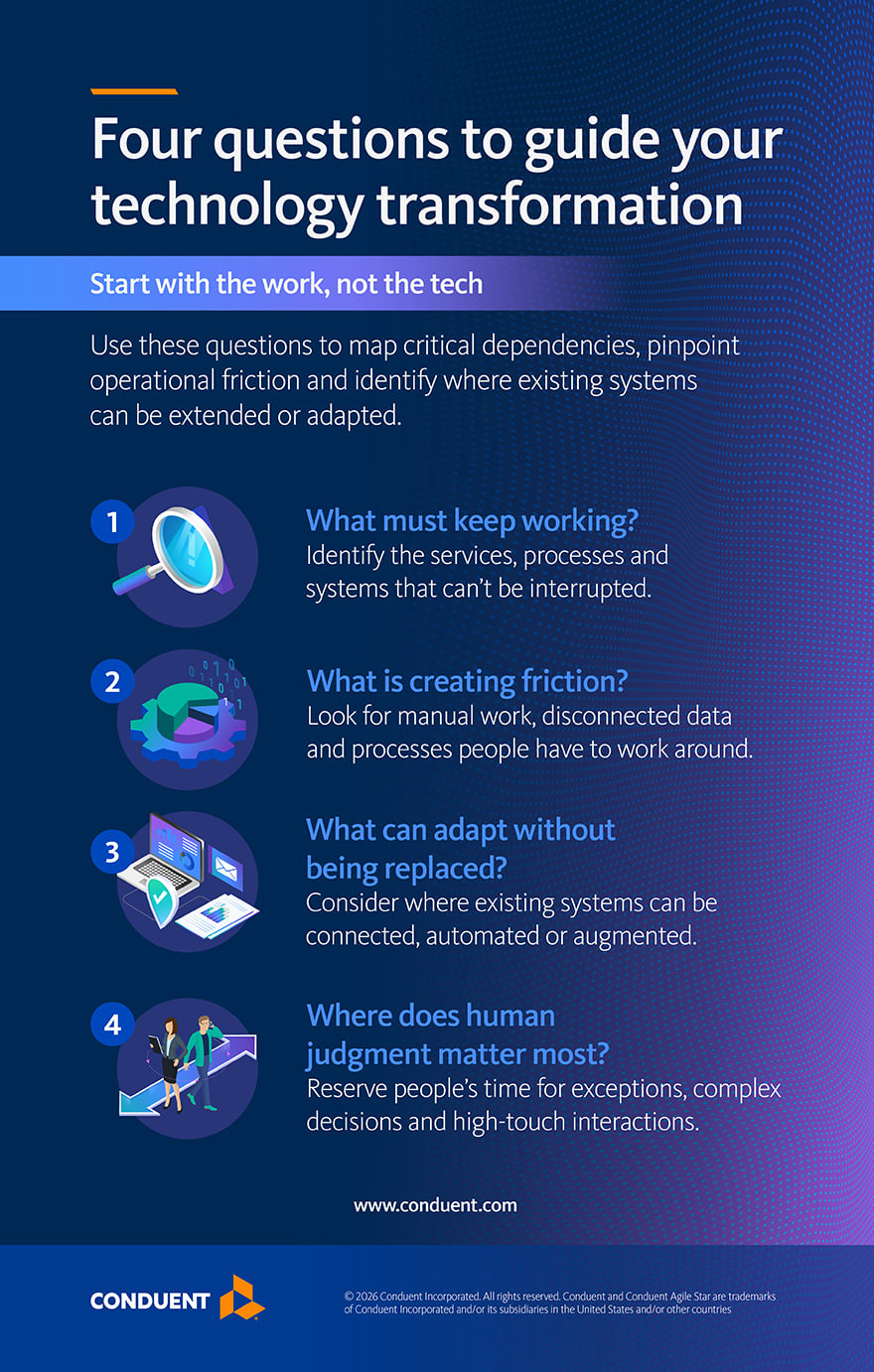
At Conduent, we’re applying those lessons to ourselves while helping clients navigate many of the same questions: What should we preserve? What needs to change? Where can technology remove friction? And where will human judgment always matter?
If your organization is asking similar questions, I hope we can continue the conversation and learn from one another as we build what comes next. Learn more, or reach out to an expert now.