If people can’t use it, it doesn’t work: A guide to government usability
Public servants recognize the loud silence that follows when a resident realizes no one can give them a clear answer.
I’ve seen it in state offices, watching as staff move between systems that almost connect, but not quite. The information is there … somewhere. But not in a way that can be easily shared or synthesized. The trust that the public puts in us slips away in these moments when something that should be simple isn’t.
Executive Order 14058 raises the bar for how services should be delivered. It calls for efficiency, accessibility and a more “human” experience. Yet many interactions still feel slow, opaque and fragmented.
Executive Order 14058 builds on federal efforts to improve customer experience. Its purpose is straightforward, albeit ambitious. The order directs agencies to focus on high-impact services, reduce administrative burden and design around the people who rely on them. It reflects a growing recognition that how government delivers is just as important as what it delivers.
Related: What trust looks like in a cloud-first government
Where systems fall short
Across agencies and functions, residents are routinely required to navigate multiple systems that do not interoperate. They are asked to re-enter the same information. They wait without meaningful direction as to status or next steps. And when issues arise, escalation paths are inconsistent or unclear.
Most agency environments reflect years of incremental change. Policy requirements evolve, and program functions and technology are added in layers. Integration is deferred or only partially achieved. Over time, this complexity compounds.
Solutions are often introduced as discrete capabilities rather than a single, cohesive architecture. They address specific functions but fail to resolve the underlying fragmentation. In some cases, they introduce new dependencies and additional points of failure. The result is a service environment that is operationally functional but experientially fractured.
From transactions to clarity
Meeting the ambition of Executive Order 14058 requires more than digitization. It requires a shift from processing transactions to delivering coherent experiences.
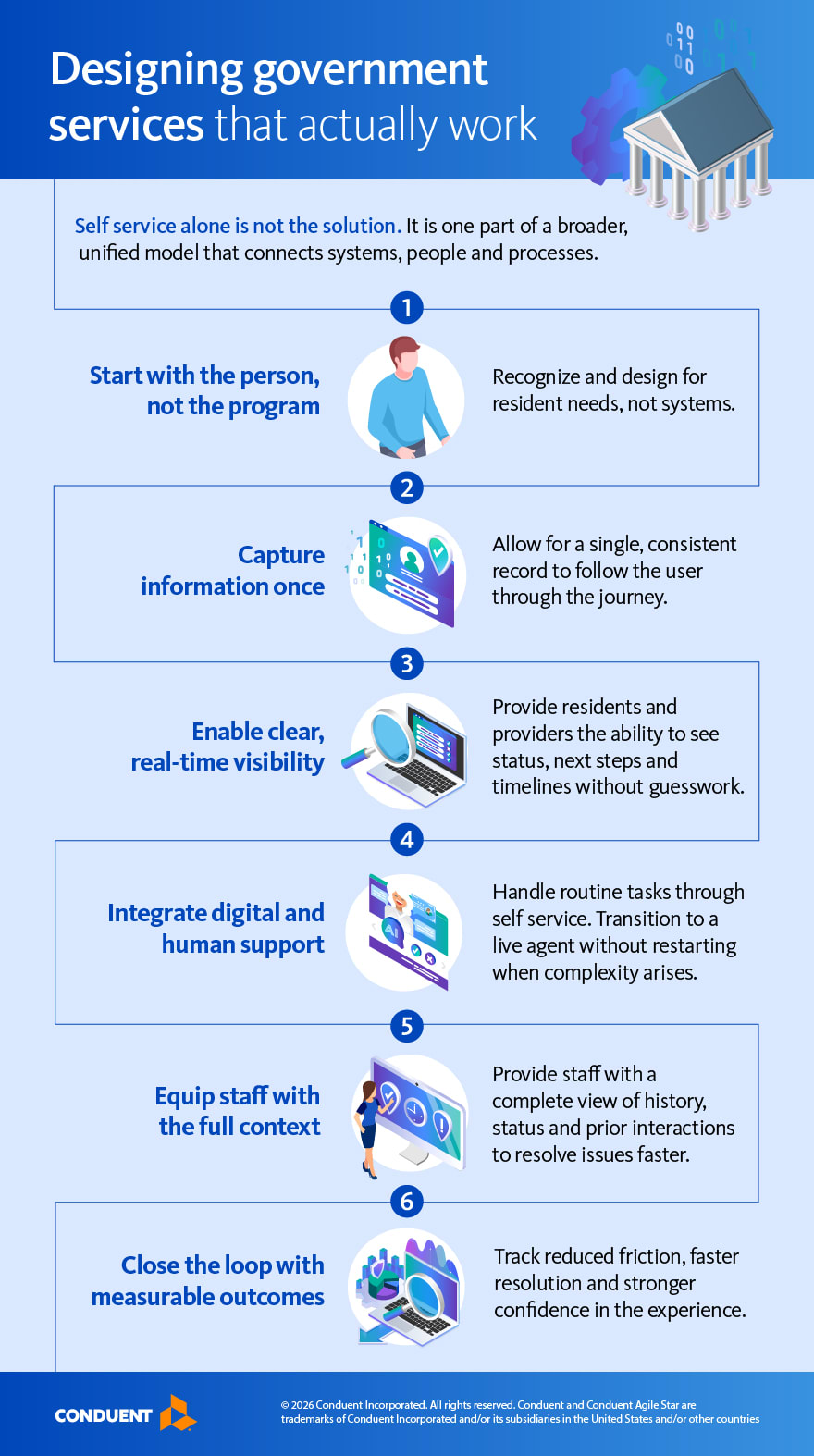
Self-service portals are central to this effort. At their best, they offer more than convenience. They provide clarity. A well-designed portal does not simply display information. It anticipates needs and presents relevant next steps while reducing uncertainty by offering real-time updates.
Agencies that invest in thoughtful design and integrated data can reduce call volumes and improve response times. More importantly, they create a sense of transparency that reinforces trust.
The limits of self service
But not every interaction can or should be automated. Complex cases require human judgment, and vulnerable populations may need assistance that can’t be replicated through a screen. Poorly designed portals frustrate users as much as outdated call centers.
Agencies must draw a careful line. While digital tools should handle routine, repeatable tasks, they should also simplify access and provide visibility.
Throughout government and even within the private sector, this balance is where many efforts falter. Portals become isolated channels rather than part of a broader service ecosystem. When escalation paths are unclear or disconnected, the experience breaks down.
Powering connected public service
How Conduent helps agencies reduce friction and deliver clearer, faster service
- Enable self service
Deliver real-time status, guided workflows and personalized next steps through BenePath® Self-Service Portal. - Unify interactions
Bring voice, chat, email and SMS into one connected experience with CXNow for Government. - Safeguard residents and transactions
Ensure real-time transaction verification to reduce risks and maintain trust and efficiency in public programs with VeriSight Anti-Fraud Solutions.
From mandate to momentum
Executive Order 14058 provides direction for these ambitions, but lasting progress depends on how agencies and their partners respond. The opportunity is to move beyond meeting requirements and toward building experiences that work. Experiences that are clear. Responsive. And worthy of trust.
At Conduent, we work alongside agencies to make that shift practical. By connecting systems, simplifying interactions and supporting both digital and human engagement, we help turn policy into progress.
The path forward is not about adding more tools. It is about making services easier to use.
Ready to get started? Learn more now, or connect with an expert.