What trust looks like in a cloud-first government: A better path to public confidence
I’ve spent nearly all of my career working at the intersection of people and systems. Long before cloud strategies and AI entered the conversation, I saw what happened when services failed to connect in the moments that mattered most.
Families and taxpayers do not experience government as programs or jurisdictions. They experience it as confusion or clarity. As delays or relief. As a handoff that works or one that sends them back to the beginning.
That perspective shapes how I think about cloud-first strategies today. Because cloud is not the goal. Interoperability is. And the outcome is trust.
Related: The quiet flex of services that deliver: How to make government services people can feel working
From fragmented systems to connected experiences
For years, cloud adoption in government focused on infrastructure. Lift and shift. Cost savings. Data centers replaced by contracts. That work was necessary, but it was not sufficient.
What agencies are grappling with now is more complex. Services span federal, state and local systems. Residents move between programs and moments of need that do not align neatly with organizational boundaries. When platforms cannot talk to one another, the burden shifts to the person asking for help.
Hybrid and multi-cloud environments are no longer transitional states. They’re the reality of modern government. The real question is whether those environments are designed to work together in service of the people who rely on them.
Interoperability is what turns cloud from a technology decision into a service strategy.
Related: In government, the era of “please hold” may soon be over
Different agencies. Different needs. Shared responsibility.
Federal, state and local agencies operate at different scales, with different mandates and constraints. But they share a common responsibility to deliver services people can understand and trust.
Federal agencies often focus on policy, consistency, oversight and national scale. States translate those policies into programs that must flex across regions and populations. Local agencies are closest to the people they serve, often operating with fewer resources and less room for error.
Residents experience those differences in very real ways. A military veteran navigating federal benefits has different expectations than a parent applying for childcare assistance at the county level. A senior seeking transportation support values clarity and continuity more than speed alone.
Cloud-first strategies must respect those differences. A one-size-fits-all approach creates new friction. Interoperable platforms allow agencies to meet people where they are, without forcing every system to look the same.
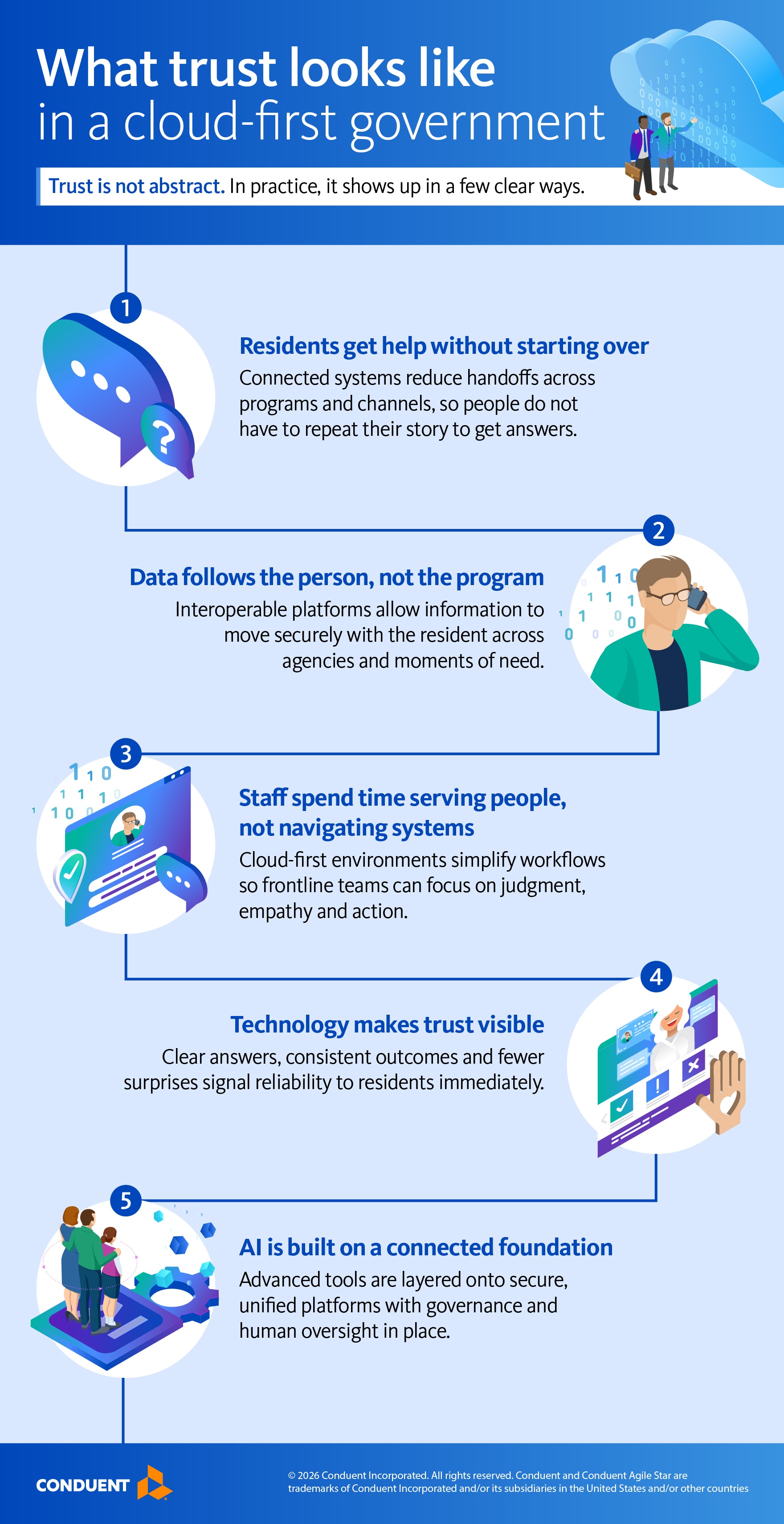
Five ways modern cloud-first government systems build trust with residents: connected services, person-centered data sharing, streamlined staff workflows, transparent outcomes, and AI built on secure, unified platforms.
Where AI fits and where it does not
There is tremendous pressure to layer AI onto every part of government operations. Used thoughtfully, it can help agencies manage complexity and support better decisions. Used carelessly, it can amplify fragmentation and erode trust.
AI depends on connected, high-quality data. Without interoperability, it cannot deliver meaningful value. Worse, it can create opaque experiences that leave residents feeling unheard or trapped in automated loops.
Technology should never prioritize organizational efficiency over human dignity. There are moments when people need a human voice. Someone who can listen, interpret context, and recognize when the real issue is not the one being asked about.
AI should support that work, not replace it. It should help public servants see patterns, anticipate needs, and intervene earlier. It should never become another barrier between people and help.
Building platforms with purpose
Cloud-first strategies succeed when they are anchored in a simple principle. Technology must make things easier for residents.
That means platforms designed for coordination across agencies. Data that follows the person, not the program. Systems that allow public servants to act with clarity rather than work around limitations.
Interoperability is not just a technical requirement. It is a reflection of how seriously we take the responsibility of service.
Where Conduent helps
Cloud-first strategies succeed when agencies can turn vision into execution. Conduent helps agencies do that by building and operating cloud-based platforms that connect systems, data and service channels around the people they serve.
We support hybrid and multi-cloud environments that respect existing investments while enabling interoperability across programs. This allows agencies to reduce handoffs and give staff the context they need to respond more effectively.
How Conduent helps
- Connect agency systems around the resident
- Simplify service across channels
- Apply AI with governance and oversight
When advanced capabilities like generative AI are introduced, they are built on this connected foundation, with governance and human oversight in place. The goal is not automation for its own sake, but technology that improves reliability, preserves trust, and supports the public servants doing the work every day.
Support your mission with reliable solutions
Conduent helps government agencies deliver services that are secure, scalable, and designed around real resident needs so you can focus on what matters most. Learn more now at https://www.conduent.com/government-solutions/.