Modernizing legacy IT in finance: a checklist for compliance and ROI
Legacy technology is holding financial systems back. It is a structural risk that strains compliance, inflates operating costs and restricts the ability to innovate. Organizations — especially those in highly regulated sectors such as financial institutions and government finance agencies — face increasing pressure to modernize aging platforms while maintaining business continuity and meeting stringent regulatory requirements.
For senior IT and strategy executives, the challenge isn’t deciding whether to modernize. It’s determining how to do it in a way that is compliant, cost efficient and aligned to long-term transformation goals. With deep expertise across financial services, we help institutions modernize at scale with compliance always in mind.
The risks of legacy IT in finance
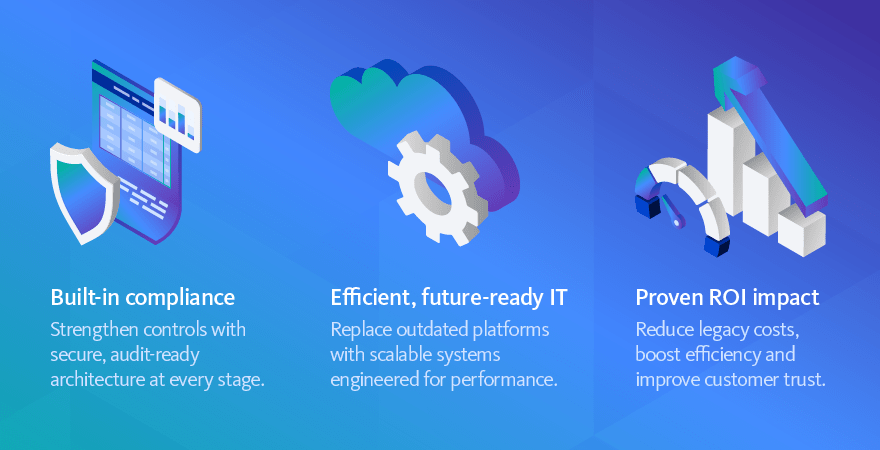
Financial leaders know that audit readiness, data governance and regulatory alignment must be embedded at every step to achieve measurable ROI. Outdated systems can be a detriment to achieving healthy ROY, causing unnecessary exposure across compliance, performance, cost management and customer trust.
Rising compliance challenges
Regulators expect precise reporting, defensible audit trails and strong controls over sensitive financial data. Yet legacy systems often lack built-in governance features and make it difficult to demonstrate compliance. Manual workarounds become common, increasing the likelihood of errors and audit findings.
Data privacy standards also continue to evolve. From GLBA to SOC 2 to PCI-DSS, institutions using older platforms face escalating risk when systems cannot support encrypted communication, role-based access or tamper-proof logs.
Hidden costs of outdated platforms
Legacy systems drain budgets through maintenance contracts, aging hardware, specialized IT support and brittle custom code. These resources cover basic system upkeep rather than innovation or strategic priorities. Over time, what seems cost efficient becomes a significant burden on IT financial management and financial system management.
Limited agility and declining customer experience
Legacy solutions make it difficult to launch new digital services, integrate with fintech partners or support omnichannel customer experiences. Slow batch processing, rigid workflows and fragmented data prevent teams from responding quickly to market changes — and today’s users feel those gaps immediately.
Modernization is not simply a technology refresh. It is a defensive strategy against operational and compliance risk. Here are five, practical steps financial leaders can take to stay up to date efficiently and responsibly.
5-stage checklist for modernizing legacy IT in financial services
Modernizing financial IT requires structure. Our roadmap helps leaders take a step-by-step approach that aligns regulatory requirements, financial outcomes and long-term transformation.
Stage 1 – Assessment
Identify risks and compliance gaps
Before any technical decisions are made, institutions must evaluate current systems against regulatory frameworks and operational needs. This includes identifying redundant platforms, unsupported software, manual data-handling processes and gaps in audit readiness.
A thorough assessment ensures the modernization plan is anchored in risk reduction and business value.
Checklist:
- Document all legacy systems and dependencies
- Map data flows and identify manual, high-risk processes
- Review current audit findings and compliance gaps
- Evaluate cybersecurity controls and access rights
- Prioritize risk areas based on regulatory exposure and business impact
Stage 2 – Design
Map financial systems to regulatory frameworks
Modern solutions must reflect the regulatory reality in which financial institutions operate. During design, IT leaders document data flows, access controls, encryption needs and reporting requirements.
Aligning architecture to compliance requirements upfront avoids costly rework later and ensures solutions scale with evolving regulations.
Checklist:
- Define target-state architecture and migration strategy
- Align system design to SOC 2, PCI-DSS and other relevant frameworks
- Establish data governance, encryption and retention requirements
- Define APIs and integration points with existing workflows
- Build a security-by-design blueprint
Stage 3 – Migration
Transition core services securely
Migrating financial data demands precision. Institutions must protect sensitive information, maintain service availability and manage dependencies across systems.
Secure migration uses structured cutover plans, automated data validation and strong change-management protocols. For many institutions, this is where IT services for banks and managed IT services for finance provide essential support.
Checklist:
- Validate all data and normalize formats before migration
- Conduct security testing before cutover
- Implement automated validation and reconciliation processes
- Confirm rollback and continuity plans
- Execute migration with staged deployment and real-time monitoring
Stage 4 – Integration
Connect modern solutions with legacy workflows
Few financial institutions migrate everything at once. Hybrid environments are common and require reliable interoperability.
Effective integration ensures that new systems coexist with remaining legacy platforms, creating a unified operating environment across payments, lending, accounting and compliance.
Checklist:
- Establish API gateways and secure integration patterns
- Synchronize identity access and authentication controls
- Modernize workflows tied to legacy systems
- Validate performance across channels and use cases
- Document integration for audit and governance
Stage 5 – Optimization
Track ROI and scale improvements
The final step is continuous improvement. Financial institutions measure operational efficiency, cost reductions, service performance and compliance outcomes.
Data insights guide additional enhancements, automation opportunities and process redesign. The result is a modernized and scalable financial ecosystem that delivers value over time.
Checklist:
- Measure performance improvements and cost savings
- Establish continuous monitoring dashboards
- Identify opportunities for automation or AI augmentation
- Enhance controls to reduce audit workload
- Build a roadmap for future enhancements
Embedding compliance into every stage
Modernization should not treat compliance as an add-on. It must be embedded into architecture, implementation and ongoing operations.
Secure-by-design principles
New systems should be engineered with encryption, role-based access, audit logging and data-loss prevention from day one. These features drastically reduce the risk of breaches and compliance violations.
Audit readiness as an architectural requirement
Every stage of modernization should improve auditability. Institutions benefit from automated reporting, tamper-proof logs and transparent data lineage. These capabilities are essential within IT support for financial services environments, especially those operating across multiple regulatory regimes.
Continuous monitoring
Once systems are live, financial institutions need proactive oversight. Compliance dashboards, risk alerts and automated controls help teams stay ahead of regulatory expectations and maintain strong governance at scale.
Through secure delivery models and financial services IT solutions, Conduent helps financial enterprises keep compliance continuous, not episodic.
Measuring ROI from modernization
Modernization is an investment. Demonstrating ROI is essential for boards, investors and regulators. These are the most common value drivers.
Direct cost savings
Retiring legacy platforms reduces licensing fees, infrastructure costs and specialised IT labour. Cloud-based and modern modular solutions offer flexible cost structures that adapt to business needs.
Efficiency gains
Automated processes, real-time data access and scalable workflows reduce cycle times and error rates. This directly supports improvements across lending, payments, reconciliation and customer service.
Many institutions see double-digit gains in productivity once modern systems replace manual work.
Enhanced trust and competitive advantage
Modern, secure and transparent systems improve customer confidence and enable institutions to compete with digital-native financial providers.
Strong governance also signals stability to auditors, partners and regulators — a differentiator in a crowded technology financial and financial services technology market.
Compliance and ROI as transformation drivers
By definition, legacy IT is not sustainable. It exposes institutions to escalating compliance risk, drains budgets and prevents financial leaders from achieving the speed and scale the market demands.
A structured, compliance-first roadmap makes modernization achievable. It drives measurable ROI, operational resilience and long-term value.
Conduent helps financial institutions move from outdated infrastructures to secure, modern, future-ready ecosystems. Through proven delivery models and deep expertise in financial operations and technology, we support transformation with confidence.
To learn more, explore our solutions across the finance spectrum, including:
- Banking and Finance: https://www.conduent.com/industry/banking-and-finance/
- Lending Solutions: https://www.conduent.com/bank-lending-solutions/lending-solutions/
- Finance, Accounting and Procurement: https://www.conduent.com/finance-accounting-procurement/
FAQs
What is the use of IT in finance?
Information technology enables financial institutions to manage transactions securely, improve customer experiences and meet regulatory requirements. Modern IT systems support data analytics, automation and digital channels that are essential to today’s financial operations.
What are managed IT services for financial institutions?
Managed IT services provide specialized support for maintaining secure, compliant and reliable financial systems. Providers oversee infrastructure, monitoring, disaster recovery and regulatory alignment, allowing institutions to reduce operational risk and focus on strategic priorities.
How does cyber security apply to financial services?
Cyber security protects financial data, transactions and customer information from cyber threats. Financial institutions must implement strong controls such as encryption, access management and continuous monitoring to defend against attacks and maintain regulatory compliance.