The pressure is growing to get SNAP payments right
As SNAP payment error rates become tied to state funding, states need earlier ways to find and prevent avoidable errors.
For years, SNAP’s payment error rate was mostly a measure of administrative hygiene. The metric shows whether state agencies were determining eligibility correctly, calculating benefits accurately, and fixing weaknesses through appropriate means.
But what was once a compliance metric is quickly becoming a fiscal liability. As federal policy links error rates more directly to state funding responsibility, accuracy is moving from the program integrity office to the budget table.
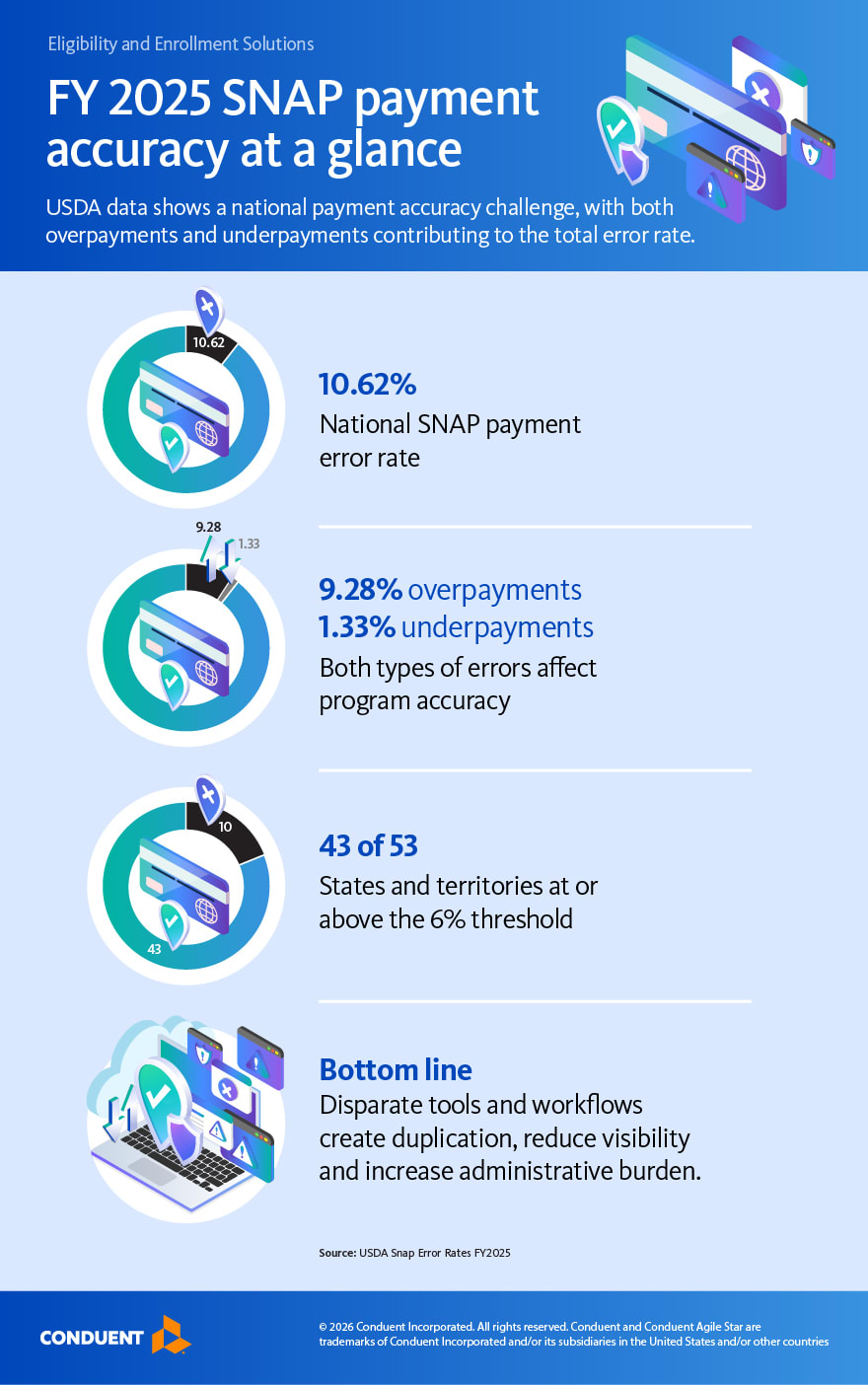
Earlier this year, USDA reported that the national SNAP payment error rate for fiscal year 2025 was 10.62%, well above the 6% congressional threshold. The figure represents $10.1 billion in improper payments, including both overpayments and underpayments.
USDA also noted that H.R. 1, the federal budget reconciliation law enacted in 2025, creates new financial consequences for states with high SNAP error rates. States at or above the 6% threshold may have to pay part of their SNAP benefit costs. Depending on the error rate, that state share could be 5%, 10% or 15%, beginning in most cases on Oct. 1, 2027.
For state agencies, the practical effect couldn’t be more straightforward: SNAP accuracy is becoming a budget liability.
Related: Brochure: Reduce SNAP payment errors and protect federal funding
Why SNAP accuracy is difficult to manage
SNAP administration is complex by design. States must determine eligibility, calculate benefits, verify household information, manage renewals and respond to changes, all while maintaining timely access for eligible residents. USDA’s quality control process measures whether households received the correct benefit amount and includes both underpayments and overpayments.
For state leaders, the challenge goes beyond identifying errors after they occur. States now need enough visibility into the eligibility process to prevent avoidable errors before benefits are authorized.
Better data at intake reduces downstream errors
Payment accuracy begins well before a caseworker ever makes a determination. Missing documents and incomplete income information can all create risk later in the process, making intake one of the most important places to prevent errors. When applicants are guided to submit complete, accurate information, agencies can reduce follow-up work and provide caseworkers with a stronger record for making decisions.
Real-time validation helps caseworkers act with confidence
SNAP eligibility decisions often depend on information from multiple systems. When those systems are disconnected, caseworkers may have to reconcile data manually, increasing the chance of missed details or inconsistent decisions.
By flagging missing, conflicting or unusual information before a case moves forward, agencies can give staff clearer information at the point of decision and reduce errors before they become part of the payment record.
Continuous monitoring gives states earlier warning signs
Federal error rates are reported after the fact, meaning the underlying issues may have been building for months before states see the full picture.
Continuous monitoring gives agencies a more current view of where risk is emerging. Dashboards, trend reporting and risk scoring can help leaders identify patterns earlier, focus on review of higher-risk cases and make targeted operational adjustments before small issues become larger findings.
How Conduent helps states strengthen SNAP payment accuracy
Our teams help agencies embed validation, analytics and digital self-service into the eligibility process. VeriSight AI-Powered Eligibility Solution supports eligibility teams with analytics that help detect fraud, identity theft and eligibility risks, while helping staff focus attention on higher-risk cases.
AI that supports SNAP payment accuracy
By analyzing information across systems, VeriSight can flag cases that may need additional review and help caseworkers focus attention where it matters most.
The goal is to give eligibility teams better visibility into missing, conflicting or unusual information at the point of decision. For state leaders, VeriSight also supports continuous monitoring by helping agencies track trends, identify emerging risk patterns and improve program accuracy before issues become formal findings.
Together, these capabilities can help agencies reduce manual processing errors, improve consistency across case decisions and identify payment accuracy trends before they become audit findings. Just as important, they support accuracy without creating unnecessary barriers for eligible residents.
Making SNAP program accuracy part of every step
The new SNAP accountability environment raises the stakes for states. But it also clarifies the path forward: make program accuracy part of every step, from application to verification to authorization to recertification to reporting.
By building accuracy into the eligibility process, states can protect funding, support compliance, and continue delivering timely access to the people who rely on SNAP.
Ready to strengthen your SNAP payment accuracy?
Conduent helps government agencies modernize eligibility and enrollment with digital tools, analytics and operational expertise designed to improve accuracy, reduce manual effort and support better resident experiences.
Visit www.conduent.com/government-solutions/eligibility-and-enrollment-solutions/eligibility-and-enrollment-services for more information, or to contact an expert.